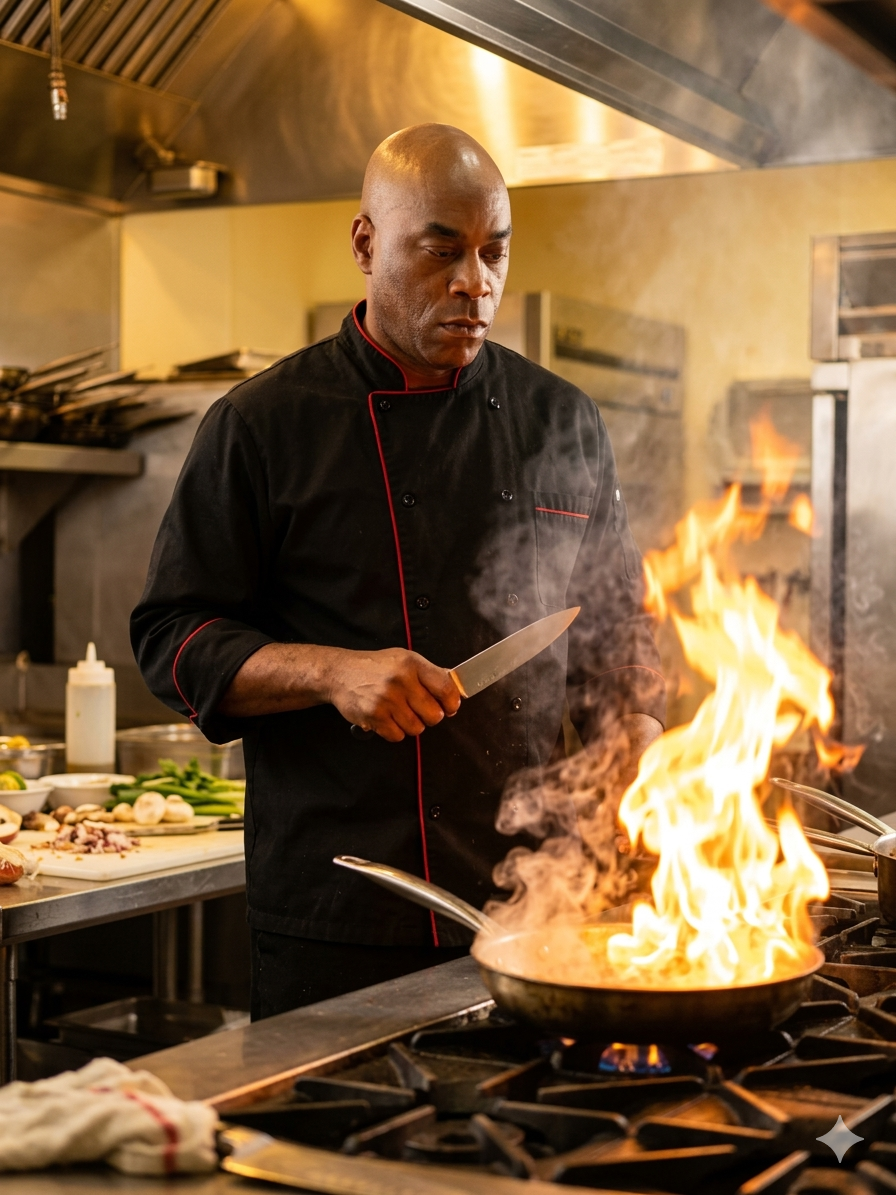
Fast Food, Casual, Upscale, Fine Dining, and Michelin: The Full Spectrum
Lesson Objective
By the end of this lesson, the student should understand the major differences between kitchen levels, what each environment teaches, and how to think about career growth across the restaurant spectrum.
Why It Matters
A lot of cooks judge kitchens too quickly. Some look down on fast food. Some romanticize Michelin kitchens. Some think casual restaurants are 'less serious.' Some think fine dining is the only real cooking.
That mindset is wrong.
Every level of the industry teaches something. A smart cook studies the advantages and limitations of each one.
Chefs evaluate new cooks from the moment they walk in. Your movement, your station, your attitude.
The Core Lesson
The restaurant industry is not one thing. It is a ladder of systems, standards, and expectations.
Fast food is built on speed, consistency, portion control, and process. You may not learn deep culinary technique there, but you will learn pace, repetition, timing, teamwork, and how to operate under constant volume. Fast food teaches people how to work. That matters.
Casual restaurants are where many cooks get their real kitchen foundation. This is where cooks start learning ticket flow, station responsibility, real prep, grill/fry/sauté coordination, and line communication. Casual restaurants often teach cooks how to survive service.
Upscale and chef-driven restaurants usually tighten standards. Now it is not enough to just get food out — the food has to be right. You begin learning precision, better mise en place, cleaner station discipline, more refined timing, and stronger accountability.
Fine dining adds another layer: visual perfection and detail. Now the dish is judged not only by taste and speed, but by plating consistency, product handling, temperature precision, and composure under refined standards.
At the Michelin-star level, detail becomes extreme. Everything matters: knife work, timing, seasoning, plate placement, micro-prep, and consistency across dozens or hundreds of covers. Michelin kitchens are often less forgiving because the margin for imperfection is much smaller.
Fast food teaches speed. Casual teaches line survival. Upscale teaches standards. Fine dining teaches precision. Michelin teaches obsession with detail. A complete cook needs pieces of all of it.
Do not chase prestige so hard that you skip foundation. A cook who can plate beautifully but cannot survive a hard rush is incomplete. A cook who can move fast but has no discipline or finesse is also incomplete. The strongest cooks combine speed, consistency, discipline, timing, standards, and awareness.
Arrive early. Arrive clean. Arrive ready to work.
The kitchen team — built on trust, speed, and communication.
Rookie Mistakes
- Thinking one type of kitchen is 'beneath' them
- Mistaking brand name for skill growth
- Chasing status over learning
- Underestimating volume kitchens
- Overestimating their readiness for elite kitchens
The Professional Standard
Ask: What can this kitchen teach me?
Ask: What pressure does it specialize in?
Ask: What skill gap in me will this place expose?
Chef Wisdom
"A smart cook doesn't just ask, 'Is this place impressive?' They ask, 'What will this place make me better at?'"
— 25 Years in Professional Kitchens
Workbook Reflection
Write your answers below. These are saved automatically in your browser.