Grill, Broiler & Flat Top Mastery
Lesson Objective
Master the three high-heat cooking stations — grill, broiler, and flat top — including heat zone management, carryover cooking, multi-protein timing, and fat management, so you can operate any of these stations under service pressure.
Why It Matters
The grill, broiler, and flat top are the most physically demanding stations in any kitchen.
They require fast decisions under intense heat, the ability to track multiple proteins at different cooking stages simultaneously, and the discipline to manage time, temperature, and texture without losing focus.
A cook who cannot operate these stations is limited. A cook who masters them becomes one of the most valuable people on the line.
These stations are where reputations are built — and where reputations are destroyed.
Professional kitchens demand precision, speed, and consistency.
The Core Lesson
The grill station is responsible for cooking proteins such as steaks, burgers, pork chops, lamb, and sometimes seafood. The defining feature of grill cooking is direct heat from open flames or hot grates. This method produces strong caramelization, smoky flavor, visible grill marks, and crisp exterior texture. These qualities are what guests are paying for when they order from the grill section of a menu — and the grill cook's job is to deliver them consistently, every ticket, every service.
Professional grills have heat zones — areas that are hotter and cooler. These zones are not a design flaw; they are a tool. An experienced grill cook uses zones deliberately: a thick steak starts in a hot zone to sear the exterior, then moves to a cooler section to finish cooking internally without burning the outside. Learning your specific grill's heat map — where the hot spots are, where the cool zones are, how they shift during a long service — is one of the first skills you develop at this station.
Carryover cooking is one of the most important concepts for any grill cook to understand. When meat leaves the heat source, it does not stop cooking immediately. The internal temperature continues to rise for 2-5 minutes depending on the thickness and density of the protein. If a steak is removed from the grill at the exact temperature requested by the guest, it will be overcooked by the time it reaches the table. Experienced grill cooks remove proteins slightly early — typically 5-10 degrees below target — to account for this effect. This is not a shortcut. It is precision.
Timing multiple proteins simultaneously is the defining challenge of the grill station. A single ticket might include a well-done burger (12 minutes), a medium steak (8 minutes), grilled chicken (10 minutes), and lamb chops (6 minutes). Each item cooks at a different speed. The grill cook must start each item in the correct order so that they all finish at the same moment. This requires mental tracking of every item on the grill at all times — not just what is there, but how long it has been there, what stage it is at, and when it needs to move or come off.
The flat top, also called a griddle, provides a large metal cooking surface heated evenly from below. Unlike the grill, there is no open flame — instead of grill marks and smoky flavor, flat tops produce a uniform crust through full surface contact. This makes flat tops ideal for burgers, pancakes, eggs, grilled sandwiches, and breakfast meats. Fat management is critical at this station: flat tops accumulate grease and food debris quickly, and a cook must constantly scrape and clean sections of the surface during service to maintain consistent heat and flavor. A dirty flat top is a slow flat top.
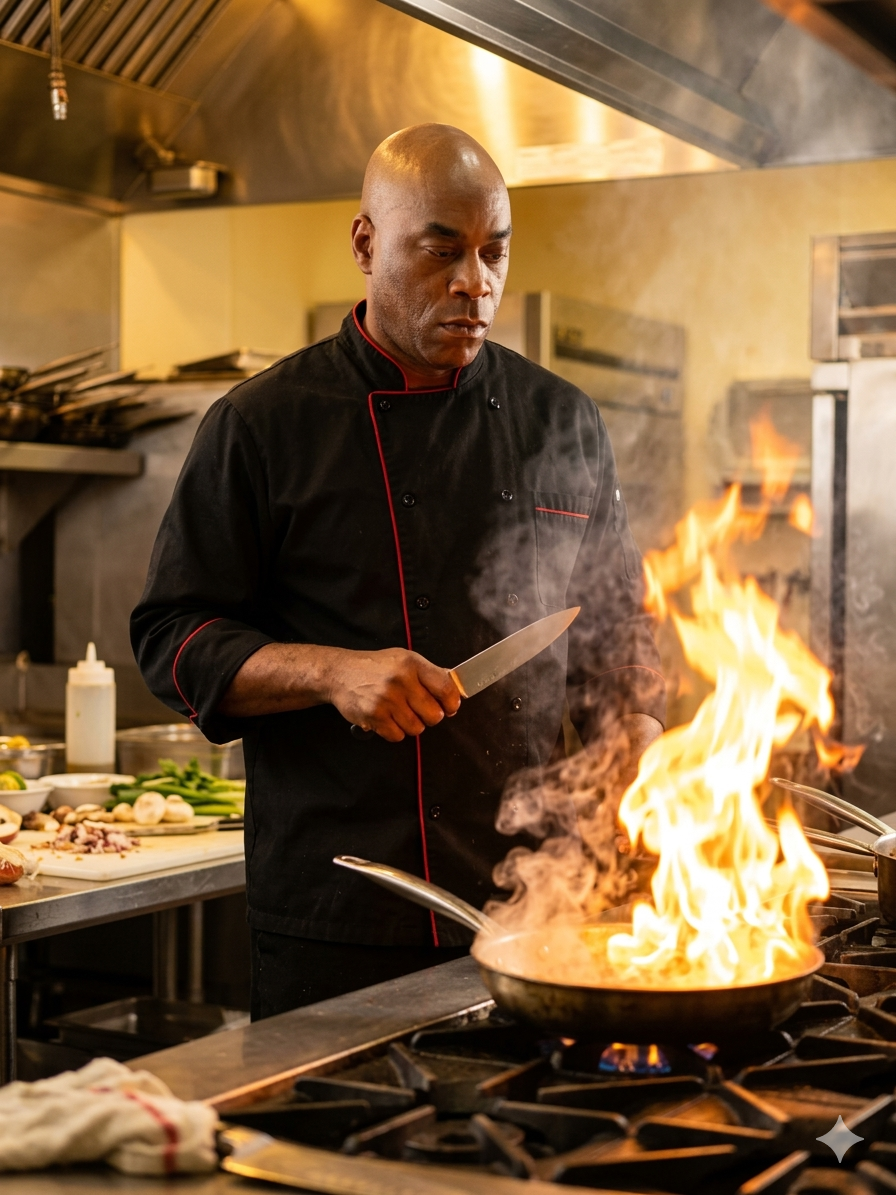
The broiler cooks food using intense radiant heat from above. Many steakhouses use overhead broilers capable of reaching extremely high temperatures — some exceed 1,800 degrees Fahrenheit. This cooking method produces strong caramelization similar to grilling but often cooks food faster. Broilers require constant attention because the heat is so intense that proteins can burn in seconds if the cook loses focus. Some broilers have adjustable racks that allow the cook to move food closer or farther from the flame depending on cooking stage — understanding this distance control is the key skill at the broiler station.
Every lesson builds toward one goal: becoming a professional who belongs on the line.
Example Scenario
A grill cook receives a ticket with a well-done burger and a medium-rare filet at the same time. The burger needs 12 minutes. The filet needs 6 minutes. If the cook puts both on at the same time, the filet will be overcooked by the time the burger is ready.
The experienced cook puts the burger on first, waits 6 minutes, then adds the filet. Both items finish at the same moment. The guest gets a properly cooked plate. This is not complicated — but it requires the cook to think ahead rather than react.
Rookie Mistakes
- Putting all proteins on the grill at the same time regardless of cooking time
- Removing proteins at exact target temperature without accounting for carryover
- Not learning the heat zones of the specific grill they are working
- Neglecting flat top cleaning during service — debris burns and contaminates flavor
- Standing too close to the broiler without understanding distance control
The Professional Standard
Know your grill's heat map — every grill has hot and cool zones, use them deliberately
Account for carryover — remove proteins 5-10 degrees below target temperature
Stage multi-protein tickets by cooking time, not by order of appearance on the ticket
Clean the flat top continuously during service — fat management is station management
Broiler distance control is a skill — learn the rack positions for each protein and cooking stage
Chef Wisdom
"The grill does not lie. Every mistake you make shows up on the plate — overcooked, undercooked, burned, pale. There is nowhere to hide at this station. That is what makes it the best teacher in the kitchen."
— 25 Years in Professional Kitchens
Workbook Reflection
Write your answers below. These are saved automatically in your browser.
Extended Study
The science behind grill cooking is the Maillard reaction — a chemical process that occurs when proteins and sugars are exposed to high heat, producing hundreds of flavor compounds that create the characteristic browned, caramelized exterior. This reaction begins at approximately 280°F and accelerates as temperature rises. This is why a properly preheated grill produces dramatically better results than a cold or lukewarm one — the surface temperature must be high enough to trigger the Maillard reaction immediately on contact.
Carryover cooking is governed by the thermal mass of the protein. A 16-ounce ribeye has significantly more thermal mass than a 4-ounce chicken breast, which means it will carry over more aggressively. Professional grill cooks develop an intuitive understanding of carryover for every protein they regularly cook — this intuition is built through repetition and attention, not just reading.
Heat zone management on a flat top is a skill that separates efficient breakfast cooks from overwhelmed ones. Professional flat top cooks mentally divide the surface into zones: high heat for initial cooking, medium heat for finishing, low heat for holding. During a busy brunch service, a skilled flat top cook may have 20-30 items on the surface simultaneously, each in the appropriate zone for its current cooking stage.
Kitchen Simulation
You are working the grill station on a Friday night. The following tickets come in simultaneously: Table 12 — two medium-rare ribeyes, one well-done burger. Table 13 — three lamb chops (medium), one grilled salmon. Table 14 — two chicken breasts, one medium pork chop. Map out your grill: what goes on first, what zone does each item start in, when does each item move, and in what order do they come off? What is your biggest timing risk in this scenario?
Mastery Questions
Can you answer these without looking back? These are the questions your certification exam will draw from.
- 1What is carryover cooking and why does it require grill cooks to remove proteins before they reach target temperature?
- 2How do heat zones on a professional grill work — and give an example of how you would use them for a thick steak?
- 3What is the difference between grill cooking and flat top cooking in terms of the result they produce on food?
- 4Why is fat management critical on a flat top station — and what happens if it is neglected during service?
- 5What is the Maillard reaction and why does it require high heat to occur properly?
Take It to the Kitchen
During your next shift on or near a grill or flat top station, observe the following: How does the cook manage heat zones? How do they track multiple proteins simultaneously? What do they do when a protein is cooking faster or slower than expected? Write your observations and identify one technique you want to apply to your own cooking.
YouTube: 'Grill Station Mastery — Heat Zones, Carryover Cooking, and Multi-Protein Timing' | Textbook Chapter: High-Heat Station Operations | Certification Module: Station Mastery Assessment | Simulation: Multi-protein grill timing exercise | Case Study: How a steakhouse grill cook manages 40 covers simultaneously