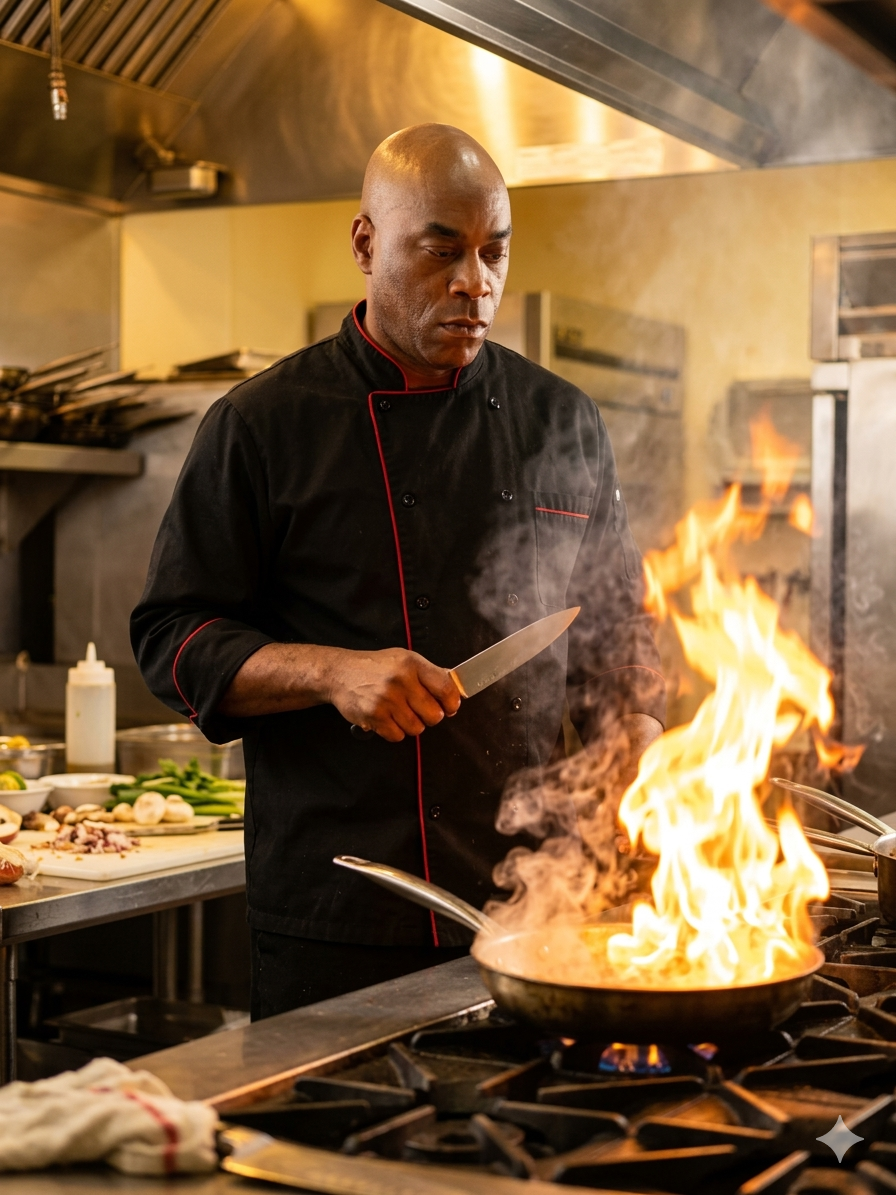
Multi-Tasking on the Line
Lesson Objective
Develop the professional ability to manage multiple pans, multiple tickets, and multiple cooking timelines simultaneously — organizing work mentally before cooking begins, maintaining a burner map, staggering start times, and controlling pace without sacrificing quality.
Why It Matters
The ability to cook one dish well is a starting point, not a destination. Professional kitchens demand that cooks manage four, six, or eight dishes simultaneously during service — each at a different stage of cooking, each with different timing requirements, each connected to other dishes on the same ticket. A cook who can only focus on one thing at a time will fall behind the moment the rail fills up. Multi-tasking on the line is not a personality trait — it is a learnable system. Cooks who understand the system can manage complexity without panic. Those who don't will always be one step behind.
Professional kitchens demand precision, speed, and consistency.
The Core Lesson
The first mistake new cooks make when multiple tickets arrive is starting to cook immediately. This instinct — to act, to move, to do something — is exactly what causes chaos. Before a single pan goes on the burner, the professional cook reads the entire rail. They scan every ticket, identify the longest-cooking items, and build a mental sequence. This 10-second planning phase prevents 10 minutes of confusion. It is the difference between a cook who controls the line and a cook who is controlled by it.
Once the sequence is established, the cook assigns burners deliberately. On a standard six-burner sauté station, each burner has a purpose. The front burners handle active proteins — items that need constant attention and frequent movement. The back burners handle sauces, reductions, and items that need heat but not constant monitoring. The cook builds a mental map: front left is the chicken, front right is the salmon, back left is the beurre blanc, back right is the pasta water. This map is not written down. It lives in the cook's working memory and is updated continuously as dishes finish and new ones begin.
Staggering start times is the core technical skill of multi-tasking. If a ticket contains a steak (10 minutes), vegetables (3 minutes), and a sauce (1 minute), the cook does not start all three at once. The steak goes on first. Seven minutes later, the vegetables go in. Nine minutes in, the sauce starts. At the 10-minute mark, all three finish simultaneously. This backward-planning approach — starting from the desired finish time and working backward to determine each start time — is the mental model that separates experienced cooks from beginners. It requires practice to internalize, but once it becomes automatic, the cook can manage six dishes across three tickets with the same clarity they once applied to a single plate.
Between active cooking moments, the professional cook uses passive time productively. While a protein sears undisturbed, the cook portions the garnish, wipes the plate, checks the next ticket, or stages the sauce. This use of passive time — the moments when food is cooking without requiring attention — is what allows experienced cooks to produce six dishes in the time a beginner produces two. Every second of passive time is an opportunity to advance the next task.
Workspace discipline is the physical foundation of multi-tasking. A cluttered station is a slow station. As dishes finish, pans are cleared. Used tools are returned to their place. Containers are closed. The station is reset to ready between each wave. This discipline is not cosmetic — it is operational. A cook who cannot find their tongs because the station is buried in dirty pans will lose 15 seconds on every dish. Over a four-hour service, those seconds become minutes, and those minutes become the difference between a smooth service and a disaster.
Staying calm under pressure is the psychological foundation of multi-tasking. When the rail fills and the noise increases and the chef is calling for a table, the body's stress response narrows attention — exactly the opposite of what the situation requires. Experienced cooks have learned to override this response through a simple technique: they slow their thinking while their hands continue moving. They take one breath, scan the rail, identify the next most important action, and execute it. Then they repeat. This deliberate slowing of mental pace — even as physical pace increases — is what allows experienced cooks to maintain clarity during the hardest moments of service.
Every lesson builds toward one goal: becoming a professional who belongs on the line.
The Three Chef Types
Scan the entire rail before starting anything. Identify the longest items. Build the sequence in your head. Then start cooking.
Assign each burner a purpose before service. Front burners = active proteins. Back burners = sauces and passive items. Know what is in every pan without looking.
Start the longest item first. Add faster items later so everything finishes simultaneously. Work backward from the finish time.
While proteins cook undisturbed, advance the next task. Portion garnish, wipe plates, check the next ticket, stage the sauce.
Clear finished pans immediately. Return tools to their place. Reset to ready between waves. A clear station is a fast station.
Example Scenario
It is 7:30 PM on a Saturday. The rail has five tickets. Ticket 1: steak medium (10 min), vegetables (3 min), mashed potatoes (30 sec reheat). Ticket 2: salmon (7 min), asparagus (4 min), lemon sauce (1 min). Ticket 3: chicken (9 min), roasted potatoes (already hot), broccolini (3 min). Ticket 4: pasta (3 min, all on your station). Ticket 5: just arrived — two steaks medium-rare (8 min) with the same sides as Ticket 1. The cook who panics starts everything at once. Within 4 minutes, the pasta is overcooked, the vegetables from Ticket 1 are done but the steak has 6 minutes left, and the salmon is burning because no one flipped it. The cook who plans reads the rail first. They identify the two medium steaks from Ticket 5 as the longest items (10 min) and start them immediately. The chicken from Ticket 3 starts 1 minute later (9 min). The salmon from Ticket 2 starts at minute 3 (7 min). The pasta from Ticket 4 starts at minute 7 (3 min). Vegetables and asparagus start at minute 6 and 7 respectively. Sauces start at minute 9. At minute 10, everything finishes together. The chef notices nothing — which is exactly the goal.
Rookie Mistakes
- Starting to cook before reading the entire rail — reacting to the first ticket instead of planning the full sequence
- No mental burner map — losing track of what is in each pan and burning food that was forgotten
- Starting all components at the same time — producing plates where one item is perfect and everything else is wrong
- Wasting passive time — standing still while proteins cook instead of advancing the next task
- Letting the station get cluttered — losing space and tools during heavy service
- Speeding up mentally when the rail fills — narrowing attention exactly when it needs to expand
The Professional Standard
Read the full rail before starting to cook — 10 seconds of planning prevents 10 minutes of chaos
Maintain a clear mental burner map at all times — know exactly what is in every pan without looking
Stagger start times deliberately — every component finishes at the same moment
Use every second of passive time to advance the next task
Keep the station clear and reset between waves
Slow mental pace when pressure increases — deliberate thinking produces faster results than panic
Chef Wisdom
"The cooks who look the most relaxed during the rush are not the ones with the easiest stations. They are the ones who planned before they cooked. When you see a cook moving smoothly through a full rail without breaking a sweat, you are watching someone who read those tickets 10 minutes ago and already knows exactly when everything finishes. That is not talent. That is a system."
— 25 Years in Professional Kitchens
Workbook Reflection
Write your answers below. These are saved automatically in your browser.
Extended Study
The cognitive science of multi-tasking in high-performance environments is well-documented in expert performance research. Studies of air traffic controllers, emergency room physicians, and professional athletes show that experts do not actually multi-task in the traditional sense — they do not divide attention equally across multiple tasks simultaneously. Instead, they use a technique called 'time-sharing': rapidly switching attention between tasks in a deliberate sequence, with each task receiving full attention for a brief period before attention shifts to the next. The key difference between experts and novices is not the speed of this switching, but the quality of the mental model that guides it. Experts have a rich, accurate mental model of the current state of every task — which allows them to predict what each task will need next and sequence their attention accordingly. In kitchen terms, the experienced cook does not watch every pan simultaneously — they have internalized the state of every pan and can predict when each one will need attention. This predictive mental model is built through deliberate practice and is the neurological basis for what cooks call 'having eyes in the back of your head.'
Kitchen Simulation
You are working the sauté station. The following tickets arrive simultaneously at 7:45 PM: Ticket A — chicken breast (9 min), broccolini (3 min), pan jus (1 min). Ticket B — salmon (7 min), asparagus (4 min), lemon beurre blanc (1 min). Ticket C — pasta primavera (4 min, all on your station). Ticket D — steak (medium, 10 min, from grill — they just fired it), your job is mushrooms (4 min) and red wine reduction (2 min). You have 6 burners. Write out: (1) your burner assignment, (2) the exact start sequence with minutes, (3) what you do during the passive time while the chicken and steak cook, and (4) the communication calls you make to the grill station and expo.
Mastery Questions
Can you answer these without looking back? These are the questions your certification exam will draw from.
- 1Why should a cook read the entire rail before starting to cook? What specific mistake does this planning step prevent?
- 2Explain the stagger timing technique. Give a specific example with three components of different cooking times.
- 3What is a mental burner map? Why is it important during heavy service?
- 4A cook has 4 minutes of passive time while a protein sears. List 5 productive tasks they should complete during those 4 minutes.
- 5A cook starts to panic when the rail fills with 5 tickets. What is the correct mental response — and what is the first physical action they should take?
Take It to the Kitchen
During your next service shift, before the rush begins, write out your burner map for the night — which burner handles which type of item. During service, track how many times you used passive time productively vs. stood idle. After service, write a one-paragraph reflection: what was the most complex multi-ticket moment of the night, how did you handle it, and what would you do differently?
Module 4, Lesson 35: Timing Multiple Dishes — the foundational timing framework this lesson builds onModule 4, Lesson 38: Active vs Passive Work — the cognitive framework for productive passive timeModule 5, Lesson 41: Psychology of the Rush — the mental control framework for high-pressure serviceKitchen Warfare Episode 16: The Multi-Ticket System — the YouTube companion to this lesson