Handling Ticket Waves Without Collapsing
Lesson Objective
Understand that ticket waves are not random chaos — they are predictable patterns of pressure — and learn the five-step response that keeps structure intact when demand surges.
Why It Matters
Service often does not arrive evenly.
It comes in waves.
Understanding ticket waves is one of the most important mental skills on the line because it helps cooks stop treating every surge as personal failure.
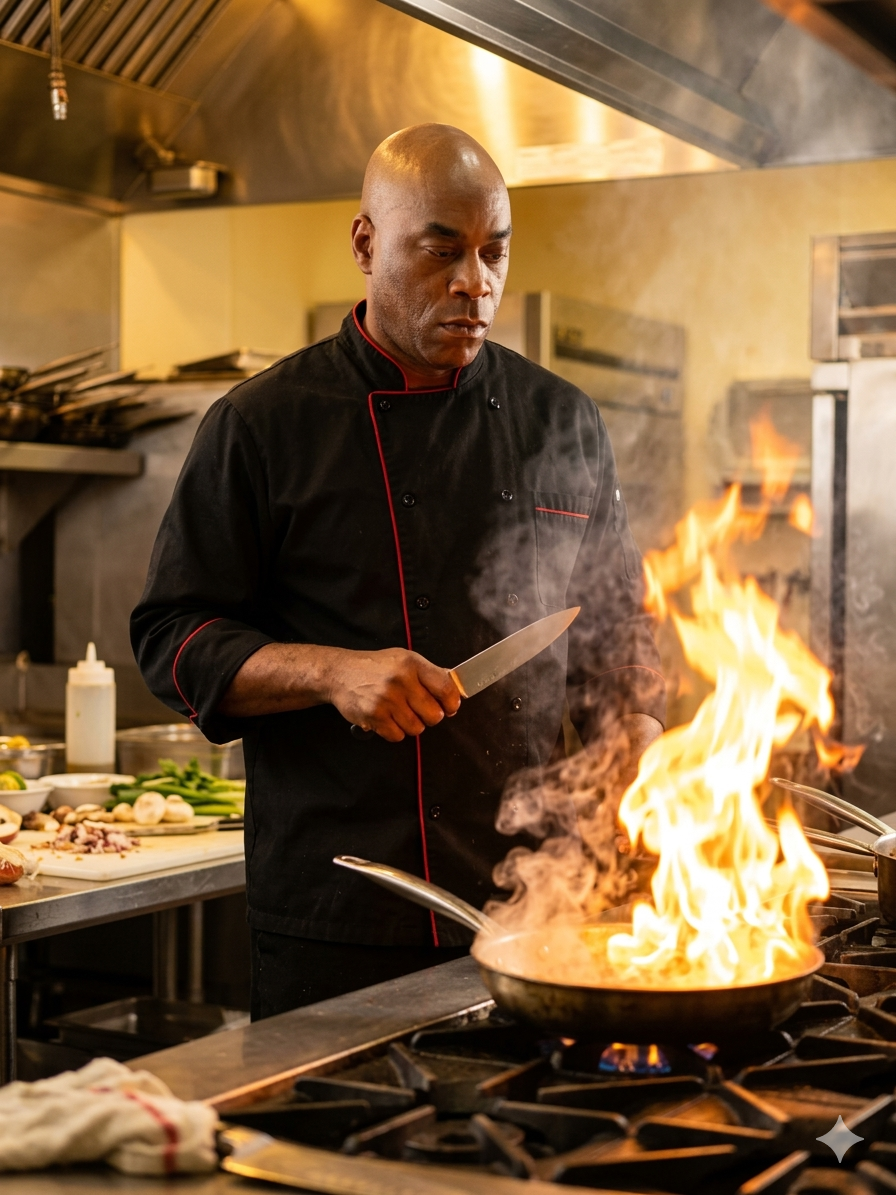
The line cook who understands the full picture — every station, every system — is the cook who advances.
The Core Lesson
A ticket wave is a sudden clustering of orders that hits one or more stations in a compressed period. It may come from a rush of tables sat together, front-of-house timing issues, online order spikes, a lull suddenly ending, or event and party timing. The key idea is this: the wave is not random chaos. It is a predictable pattern of pressure.
Waves break cooks who read only the front ticket, react emotionally, stop communicating, abandon sequence, become physically frantic, and fail to identify the real bottleneck. The issue is not the wave itself. The issue is how the cook interprets and organizes their response to it.
The correct response to a wave is structured: read the shape, identify the controlling problem, communicate early, simplify the next move, and protect station organization. This is where many cooks fail — they stop wiping, stop resetting, stop thinking. That makes the second half of the wave worse than the first. The wave does not end when the tickets stop printing. It ends when the station is back in control.
Working the line is not just cooking. It's coordination, communication, and commitment.
The Three Chef Types
What items are repeating? What station is most threatened? Do not react to individual tickets — read the pattern.
What will bury this station first: grill space, fryer capacity, protein timing, pans, garnish, backup? Name the real bottleneck.
Do not wait for visible collapse. Tell expo, tell neighboring stations, tell chef. Early communication creates shared recovery.
Not the next twenty. The next one. Under pressure, complexity kills. Focus on the single most important next action.
Keep wiping. Keep resetting. Keep thinking. The second half of the wave is won or lost by whether the station stayed organized during the first half.
Example Scenario
A fry station suddenly gets hit with: 7 fries, 3 chicken tenders, 2 calamari, 2 sandwich sides.
The weak response: panic-dropping everything without basket logic.
The stronger response: identify oil/basket capacity, sequence by pickup reality, communicate likely delay, check backup product, keep the drop order legible.
That is the difference between reacting and managing.
Rookie Mistakes
- Reading only the front ticket and getting buried by the next ten
- Reacting emotionally instead of reading the pattern
- Stopping communication when pressure rises
- Abandoning station organization during the wave
- Treating the wave as personal failure instead of a predictable pattern
The Professional Standard
Read the shape of the wave before reacting to individual tickets
Identify the controlling problem — not just the symptoms
Communicate early — not after collapse
Protect station organization through the whole wave
Chef Wisdom
"Ticket waves are not just about endurance. They are about pattern recognition, prioritization, and maintaining structure while demand surges. The cook who keeps their station organized during a wave comes out the other side in control. The cook who abandons organization comes out buried."
— 25 Years in Professional Kitchens
Workbook Reflection
Write your answers below. These are saved automatically in your browser.
Module 04 Complete
Module 4 teaches that the line is not where cooking happens — it is where timing, communication, sequencing, spatial awareness, and emotional control converge under pressure. By the end of this module, the student should understand how ticket systems really work, how to read the rail as information, how and why kitchens call orders, the four functions of line communication, the five-question timing model, how to work with expo, how to synchronize plates, how to layer active and passive work, how to work ahead intelligently, and how to handle ticket waves without collapsing.