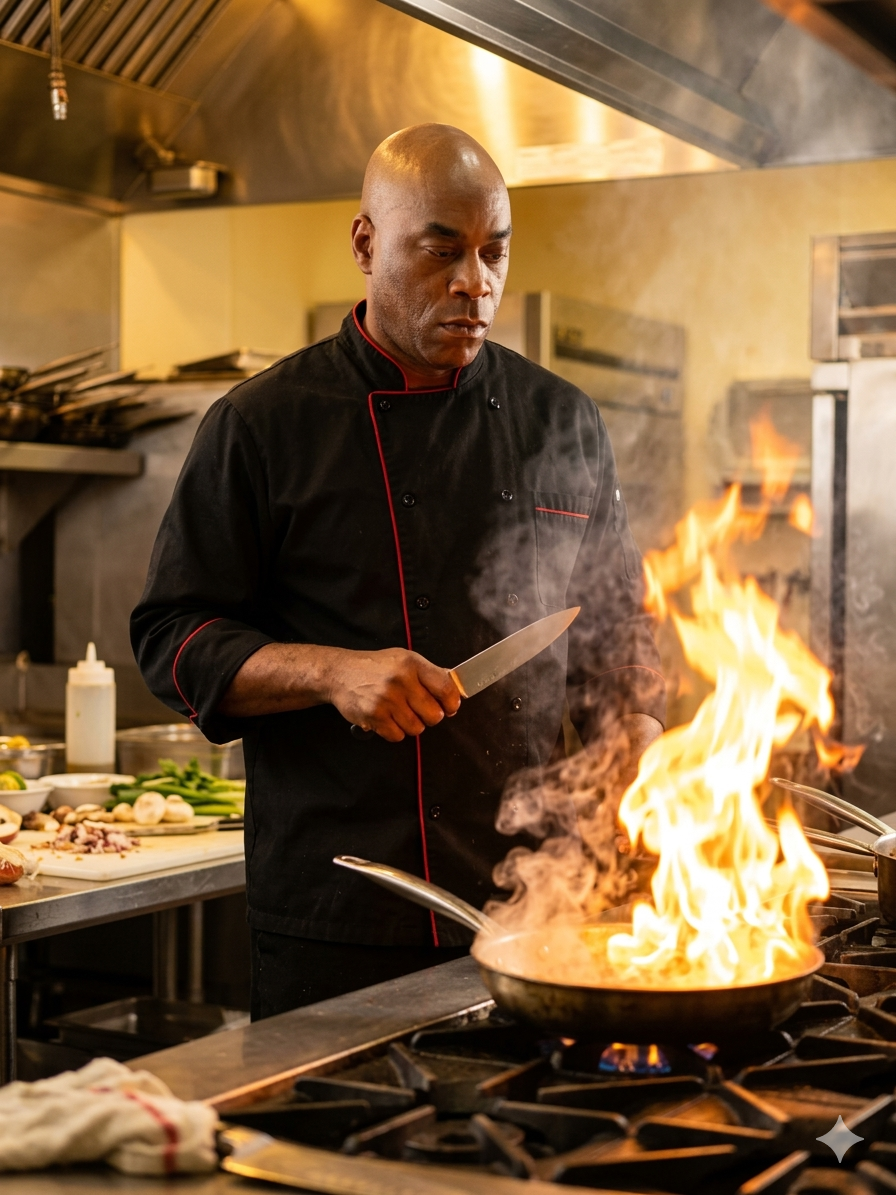
Reading the Whole Kitchen, Not Just Your Station
Lesson Objective
Develop the ability to read the whole kitchen as a living system — understanding where pressure is, where it is moving, and what ripple effects are forming — while still maintaining your own station.
Why It Matters
A cook becomes much more valuable the moment they stop living inside a single square of stainless steel mentally.
A station matters. But kitchens are not isolated islands. They are interdependent systems.
One of the major differences between a cook and someone beginning to think like a chef is the ability to read the whole line, the whole service, and the whole pressure picture.
Becoming valuable means thinking beyond your station.
The Core Lesson
Reading the kitchen means understanding: where the pressure is, where the pressure is moving, which station is close to collapse, what item is currently controlling service, what person needs help, what hidden issue is about to become public, and what chef is worried about even if chef has not said it yet. Beginners see events. Strong cooks see relationships between events. That is the fundamental shift — from seeing what is happening to understanding what it means.
A kitchen is not just grill + fry + sauté + salad + dish. It is an interlocking system of volume, timing, product flow, space, labor, stress, and leadership attention. If fry gets buried, grill may begin holding proteins too long. If dish gets buried, sauté may lose pan flow. If expo loses confidence in times, the whole line becomes less coordinated. If one weak cook starts sinking, chef's attention shifts, and other stations get less support. This is why chefs read the room constantly — they are not just looking at food, they are watching system health.
The biggest mistake narrow cooks make is: 'I'm good as long as my station is okay.' That is not always true. If the room is failing around you, your station may soon inherit that failure: delayed pickups, dead components, extra support burden, cross-station timing damage, and leadership distraction. A stronger cook begins seeing those ripple effects earlier — not to abandon their station, but to communicate better, adjust timing, and offer support at the right moment.
To read the whole kitchen, look for: traffic changes (is movement becoming tighter or more chaotic?), repeated calls (is chef asking the same station for times again and again?), silence (sometimes a station in trouble gets quieter, not louder), dish flow (is dish backing up?), expo tension (is expo asking for more updates?), product stress (are certain items repeating on the rail?), and body language (who looks overwhelmed, scattered, or locked up?). These are leadership clues — the signals that the system is under stress before the stress becomes a crisis.
The most valuable cook in any kitchen is the one who makes everyone else better.
Example Scenario
You are on grill and technically 'fine.' But you notice: fry is now low on backup and getting ticket-heavy, sauté is stacking pans and losing board clarity, expo has asked two times for one missing pickup, and dish is slow returning critical pans.
A weak cook says, 'Not my problem yet.'
A stronger cook stores the information and asks: What effect will that have on my timing? Do I need to communicate differently now? Can I help at a useful moment without losing grill? What pressure is about to spread?
That is whole-kitchen reading — maintaining your station while understanding the system around it.
Rookie Mistakes
- Thinking 'I'm fine as long as my station is okay' — the room's problems become your problems
- Only seeing events, not relationships between events
- Not noticing when a neighboring station is approaching collapse
- Ignoring expo tension — expo frustration is a system warning signal
- Treating whole-kitchen awareness as someone else's job
The Professional Standard
Beginners see events — strong cooks see relationships between events
Read the seven signals: traffic, repeated calls, silence, dish flow, expo tension, product stress, body language
Maintain your station while developing wider awareness — these are not competing
The room's problems will eventually become your problems — see them early
Chefs watch system health, not just food quality
Chef Wisdom
"Reading the whole kitchen means learning to see pressure as a system, not just as a personal station problem. That is one of the first real signs of chef-level awareness."
— 25 Years in Professional Kitchens
Workbook Reflection
Write your answers below. These are saved automatically in your browser.