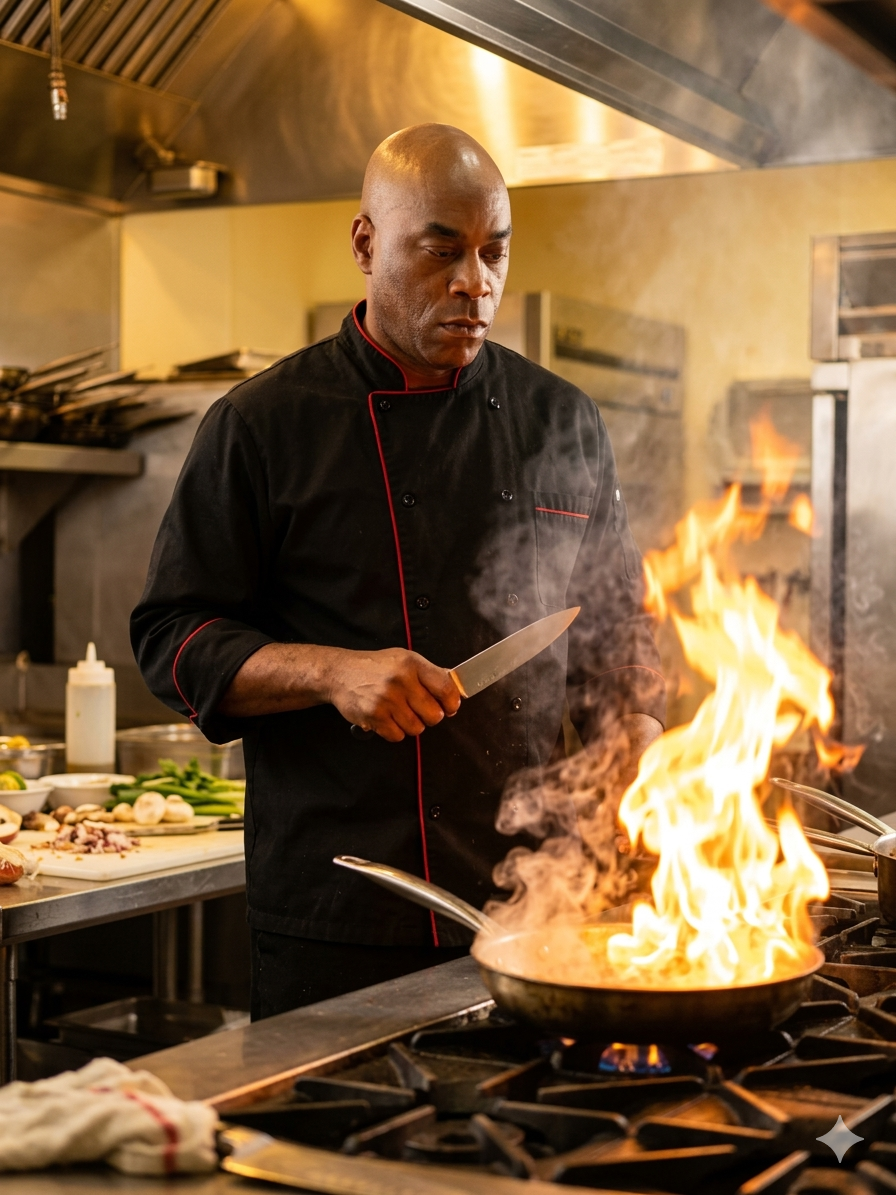
Training New Cooks: Why Teaching Others Exposes the Quality of Your Own Thinking
Lesson Objective
Understand that teaching is not just a leadership responsibility — it is a diagnostic tool that reveals the depth of your own understanding. Build a strong kitchen teaching model that actually transfers skills.
Why It Matters
Many cooks think leadership begins when they get a title.
Not true.
Leadership often begins the first time someone newer than you looks to you for guidance. The moment you have to teach, your own understanding gets tested — because teaching reveals whether you truly understand the task, whether you can explain sequence, whether you know the 'why,' not just the 'what.'
Becoming valuable means thinking beyond your station.
The Core Lesson
A kitchen becomes stronger only if knowledge is transmitted. If every skill lives only inside one person's hands, the kitchen stays fragile. That is why cooks who can train others become disproportionately valuable. Teaching is force multiplication — one skilled cook who can train three others creates more kitchen capacity than one skilled cook who cannot share what they know.
The three levels of weak teaching: demonstration without explanation ('just watch me'), explanation without structure (a flood of information with no order), and correction without diagnosis (only telling the learner they're wrong, but not why). All three create confusion. The learner may be able to imitate what they saw, but they cannot adapt it, troubleshoot it, or teach it to someone else. Weak teaching creates dependency, not capability.
A strong kitchen teaching sequence often looks like: show the whole task, break it into steps, explain why each step matters, let the learner do it, correct precisely, and repeat until the sequence stabilizes. That is actual training. Each step serves a purpose — the overview creates context, the breakdown creates structure, the 'why' creates understanding, the practice creates muscle memory, the precise correction creates accuracy, and the repetition creates habit.
When you teach, you are forced to clarify: what actually matters, what is style versus standard, what step controls the outcome, what beginners tend to miss, and what language makes the lesson easier to absorb. This strengthens your own thinking dramatically. The cook who can explain a task clearly has understood it more deeply than the cook who can only execute it. Teaching is the highest form of learning.
The most valuable cook in any kitchen is the one who makes everyone else better.
Example Scenario
A senior fry cook trains a new fry cook.
Weak teaching: 'Just drop this, season that, and don't screw up the rail.'
Strong teaching: 'Watch the basket capacity. Fries die fast, so they follow the controlling item. These two trays are active, this one is backup. Here's when you speak up. Here's what collapse looks like before it becomes obvious.'
The second version is training. The first is just pressure with no structure. The new cook in the first scenario has been given a task. The new cook in the second scenario has been given a system.
Rookie Mistakes
- Thinking leadership begins with a title — it begins the first time someone looks to you for guidance
- Teaching by demonstration only — 'just watch me' creates imitation, not understanding
- Flooding the learner with information without structure
- Correcting without diagnosing — telling someone they're wrong without explaining why
- Not teaching because 'it's faster to just do it myself' — this keeps the kitchen fragile
The Professional Standard
Teaching is force multiplication — one skilled cook who can train others creates more capacity
Strong teaching sequence: show whole → break into steps → explain why → let them do it → correct precisely → repeat
Explain why each step matters — understanding creates adaptability, imitation does not
Teaching exposes the quality of your own thinking — if you cannot explain it clearly, you do not yet understand it deeply
The goal is capability, not dependency — teach so the learner can eventually teach someone else
Chef Wisdom
"Teaching exposes the quality of your own thinking. If you can explain and transfer a skill clearly, you probably understand it more deeply than you realized. Teaching is not just leadership — it is the highest form of learning."
— 25 Years in Professional Kitchens
Workbook Reflection
Write your answers below. These are saved automatically in your browser.