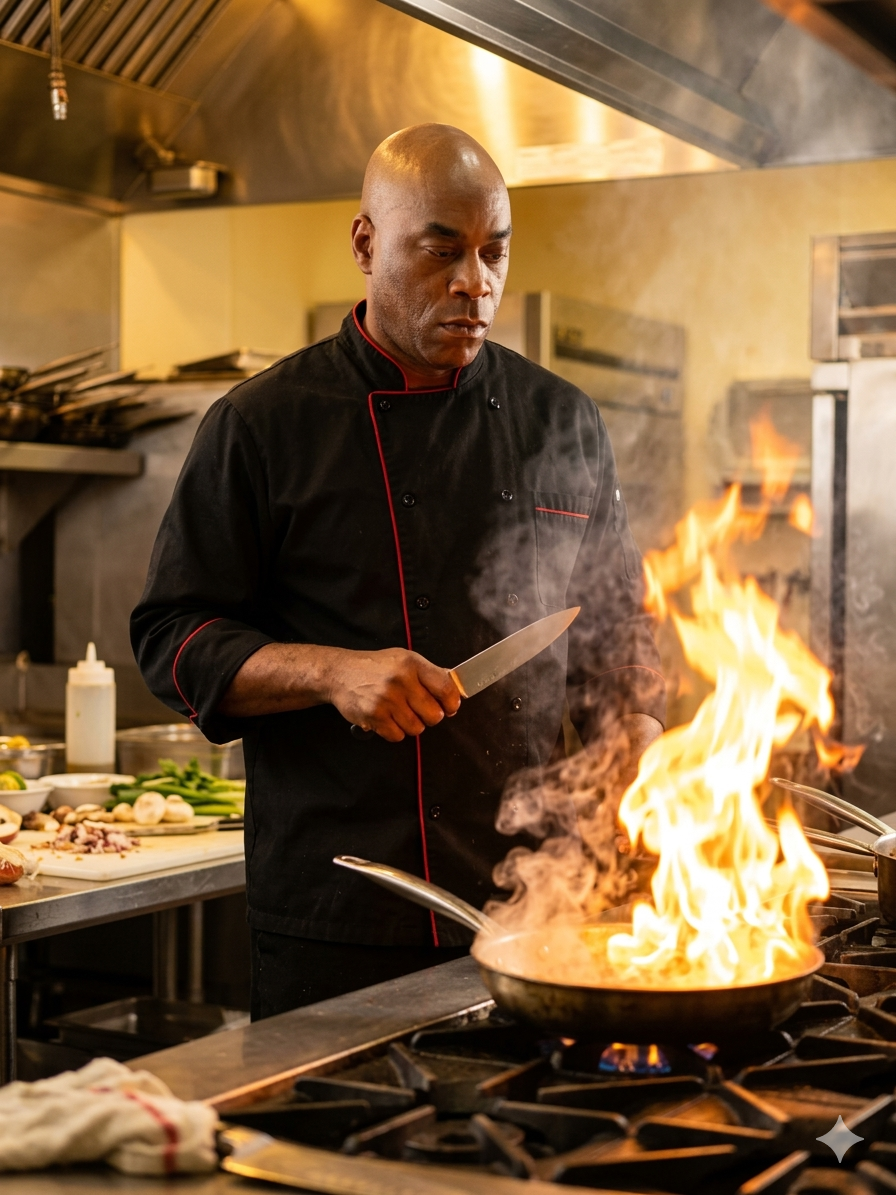
Communication Leadership: How the Best Cooks Make the Room Clearer
Lesson Objective
Understand the difference between noise and communication leadership — and build the habit of speaking in ways that reduce uncertainty, create action, and make the kitchen easier to run.
Why It Matters
There is ordinary kitchen communication, and then there is communication leadership.
Communication leadership means you do not just pass information — you improve clarity in the room.
That matters because unclear kitchens become emotional faster than clear kitchens. When the room is unclear, stress rises.
Becoming valuable means thinking beyond your station.
The Core Lesson
A cook with communication leadership: surfaces problems early, answers questions directly, gives honest times, reduces confusion, helps sequence pressure for others, and speaks in ways that create action, not noise. This is a huge leadership trait because clarity lowers stress. The cook who makes the room clearer is the cook who makes everyone's job easier — and that is noticed, remembered, and rewarded.
To speak clearly is to make your station visible. Weak cooks often protect ego by speaking late or vaguely — they do not want to be wrong, they do not want to be held accountable, they do not want to admit a problem. Strong cooks protect service by speaking clearly — they understand that a late warning is worse than an early honest one, and that vague communication creates more work for everyone. That is a major maturity difference.
Communication leadership language is short, useful, timely, honest, and coordinated. It creates action. It reduces uncertainty. It helps the room sequence itself. The cook who can communicate like this is the cook who makes service easier to run — and that is one of the most valuable things a cook can do for a kitchen.
The most valuable cook in any kitchen is the one who makes everyone else better.
The Three Chef Types
Dramatic updates. Excuse-heavy explanations. Vague statements. Emotional tone without useful content. Repeated talking that adds no structure. Creates confusion and raises stress.
'Low on salmon, one backup left.' 'Need three minutes on refire.' 'Fry is getting hit hard, watch side timing.' 'Burger controls this pickup.' Short, useful, timely, honest, coordinated. Creates action and reduces uncertainty.
Example Scenario
Write five examples of weak communication and five examples of strong communication.
Weak: 'I don't know, maybe five minutes? It's been crazy back here.' Strong: 'Four minutes on the duck, it needs to rest.'
Weak: 'Someone messed up the prep and now we're low on everything.' Strong: 'Low on salmon, two portions left, need a restock before the next wave.'
Then compare the emotional load each creates. The weak versions add uncertainty and blame. The strong versions add information and direction.
Rookie Mistakes
- Speaking late to protect ego — a late warning is worse than an early honest one
- Being vague to avoid accountability — vagueness creates more work for everyone
- Confusing talking with communicating — volume is not clarity
- Giving dramatic updates instead of useful information
- Not surfacing problems early because it feels exposed
The Professional Standard
Communication leadership: reduce uncertainty in the room
Short, useful, timely, honest, coordinated — that is leadership language
Surface problems early — a late warning is worse than an early honest one
Speak in ways that create action, not noise
The best cooks do not just work hard — they make the kitchen easier to read
Chef Wisdom
"Communication leadership is the ability to reduce uncertainty in the room. The best cooks do not just work hard — they make the kitchen easier to read. That is one of the most valuable things a cook can do."
— 25 Years in Professional Kitchens
Workbook Reflection
Write your answers below. These are saved automatically in your browser.