
Inventory Discipline — The Foundation of Kitchen Control
Lesson Objective
Understand how inventory discipline directly controls food cost, waste, and kitchen profitability — and build the daily habits that make it automatic.
Why It Matters
Most kitchens lose 5–10% of their food cost to waste, spoilage, and over-ordering — not to bad cooking, but to bad inventory habits. A cook who understands inventory is not just a better cook; they are a more valuable employee. Chefs notice who tracks product and who doesn't. Inventory discipline is one of the clearest signals of professional maturity.
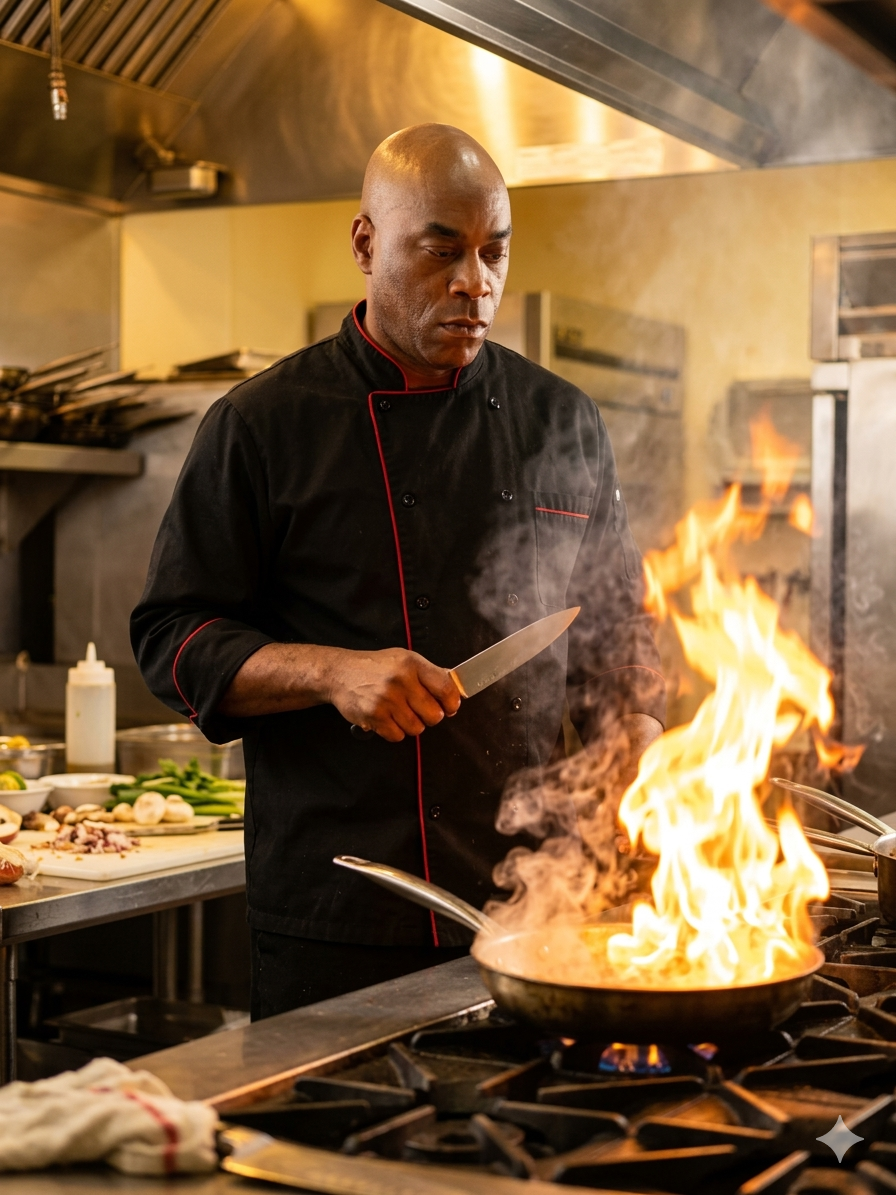
Kitchen control systems: the frameworks that make great kitchens run consistently.
The Core Lesson
Inventory discipline is the practice of knowing exactly what you have, what you need, and what you are losing — before service, during service, and after service. It is not a management task. It is a cook's daily responsibility.
The first principle of inventory discipline is **receiving correctly**. When product arrives, it must be checked against the order: correct quantities, correct quality, correct temperature. A cook who accepts a delivery without checking it is accepting responsibility for everything wrong with it. Bruised produce, short counts, and warm proteins all become the kitchen's problem the moment they are signed for.
The second principle is **rotation**. Product must be stored so that older inventory is used first. This is not just a food safety rule — it is a cost control rule. When newer product gets used before older product, the older product spoils. Every spoiled item is a direct loss of food cost percentage. A kitchen that rotates correctly wastes almost nothing.
The third principle is **par levels**. Every station should have a defined par — the minimum quantity of each item needed to run service. When inventory drops below par, it triggers a reorder. When inventory consistently exceeds par, the par is too high and product is being over-ordered. Par levels are living numbers — they change with season, menu, and volume.
The fourth principle is **waste tracking**. Every item thrown away should be recorded: what it was, how much, and why. Over time, waste logs reveal patterns — which items spoil fastest, which prep quantities are consistently over-estimated, which menu items generate the most trim waste. This data is how kitchens get smarter about ordering.
The fifth principle is **accountability**. Every cook is responsible for the inventory on their station. If product is wasted, mis-stored, or mis-labeled on your station, that is your accountability. Professional cooks treat product like money — because it is.
Systems replace reliance on individual talent. Great kitchens run on systems.
Example Scenario
A prep cook receives a delivery of 20 pounds of salmon. Without checking, they sign for it and put it in the walk-in. The next morning, the chef discovers 4 pounds are discolored and unusable — they were already borderline when they arrived. The kitchen absorbs a $40 loss and has to 86 the salmon special. A cook with inventory discipline would have caught this at receiving, rejected the bad product, and documented the discrepancy with the supplier.
Rookie Mistakes
- Signing for deliveries without checking temperature, quality, or count
- Storing new product in front of old product instead of rotating
- Not labeling items with date and contents
- Throwing away product without recording it in a waste log
- Treating inventory as management's problem rather than a cook's daily responsibility
The Professional Standard
A professional cook checks every delivery against the order, rotates all product correctly, maintains accurate par levels, and tracks waste without being asked. They treat every item in the walk-in as money that belongs to the restaurant — because it does.
Chef Wisdom
"The walk-in is a bank. Every item in it has a dollar value. When you waste product, you are not throwing away food — you are throwing away money that the restaurant already spent. Chefs who understand this think differently about every item they touch."
— 25 Years in Professional Kitchens
Workbook Reflection
Write your answers below. These are saved automatically in your browser.
Extended Study
Inventory management in professional kitchens is a discipline with deep roots in both food science and financial management. The concept of par levels derives from manufacturing's 'reorder point' theory — the quantity at which replenishment must be triggered to avoid stockout. In restaurant contexts, par levels must account for lead time (how long between order and delivery), usage rate (how much is consumed per service), and safety stock (buffer for unexpected demand spikes). The financial impact of poor inventory discipline compounds quickly: a restaurant doing $1 million in annual food purchases that wastes 8% of product loses $80,000 per year — enough to fund two full-time cook positions. The National Restaurant Association estimates that the average restaurant loses 4–10% of food purchases to waste, with poor receiving and rotation practices being the primary causes.
Kitchen Simulation
You are the opening prep cook. A delivery arrives: 15 lbs ground beef, 10 lbs chicken breast, 5 lbs salmon, 3 cases produce. The ground beef feels warm — the driver says it's fine. The salmon count is 4 lbs short. The produce has some soft tomatoes mixed in. Walk through exactly what you do: what you accept, what you reject, what you document, and how you store what you keep.
Mastery Questions
Can you answer these without looking back? These are the questions your certification exam will draw from.
- 1What is a par level and why does it change with season and volume?
- 2Describe the correct procedure for receiving a protein delivery that arrives at questionable temperature.
- 3What is the financial impact of consistently over-ordering above par levels?
- 4Why is waste tracking more valuable than simply minimizing waste?
- 5A cook discovers that 3 lbs of chicken in the walk-in expired yesterday. What are the correct steps?
Take It to the Kitchen
For one full week, track every item you throw away on your station: what it was, how much, and why. At the end of the week, total the estimated cost of all waste. Identify the single biggest category of waste and write one habit change that would eliminate it.
Study ServSafe food handler certification materials on receiving and storageResearch FIFO (First In, First Out) rotation systems used in large-volume kitchensRead about restaurant food cost management in 'The Restaurant Manager's Handbook' by Douglas Brown