
Flat Top and Fryer Cleaning
Lesson Objective
Master the professional cleaning procedures for flat top griddles and commercial deep fryers — including oil filtration, fryer breakdown, and flat top conditioning.
Why It Matters
Flat tops and fryers are the two pieces of equipment most commonly cleaned incorrectly in professional kitchens. Improper flat top cleaning damages the cooking surface. Improper fryer maintenance degrades oil quality, increases food cost, and creates fire hazards. These are not minor issues — they affect food quality, equipment lifespan, and kitchen safety every day.
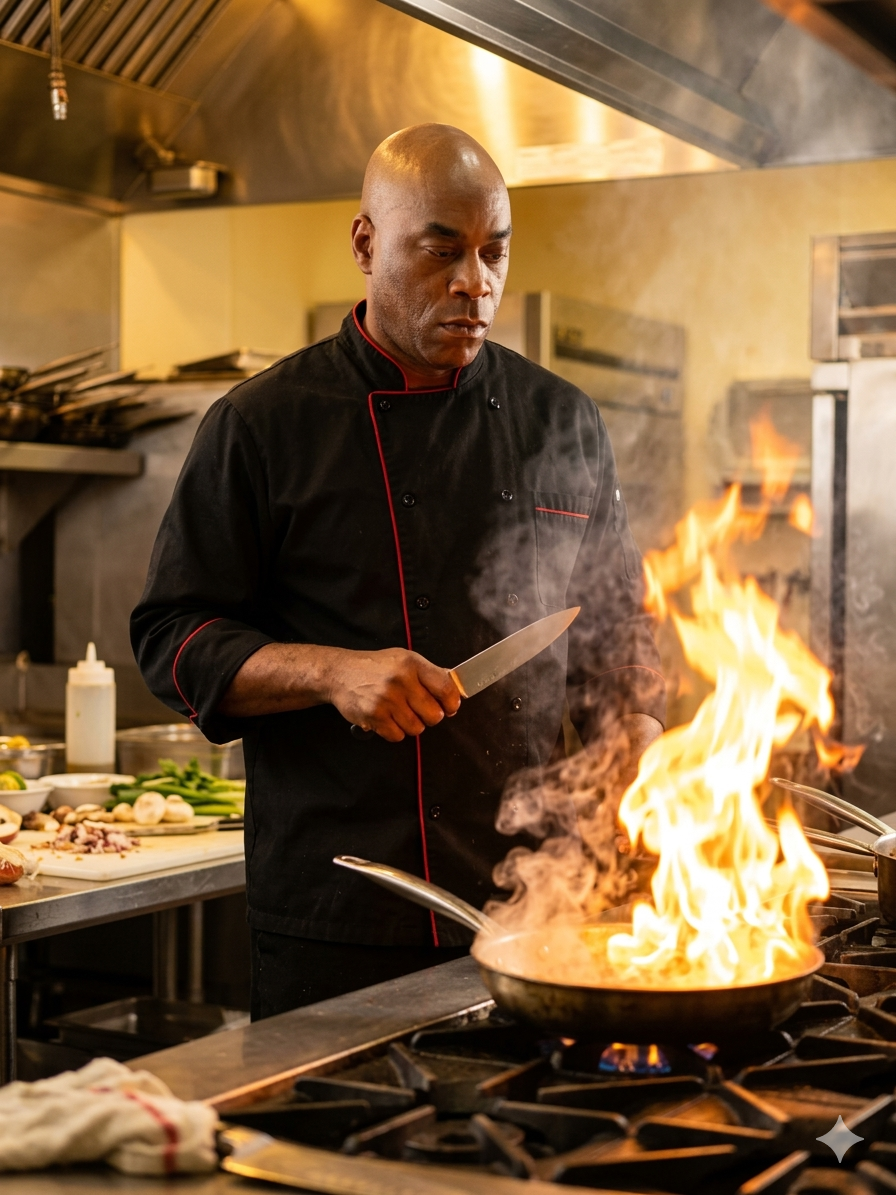
Kitchen control systems: the frameworks that make great kitchens run consistently.
The Core Lesson
**FLAT TOP CLEANING**
The flat top griddle requires a different cleaning approach than the grill because it has a solid cooking surface rather than open grates. The goal is to maintain a clean, seasoned surface that provides even heat distribution and non-stick performance.
During service, the flat top is cleaned with a flat top scraper and a damp cloth or griddle screen. Food residue is scraped to the grease trough and removed. This is not a deep clean — it is maintenance cleaning that keeps the surface functional during service.
The end-of-service flat top clean follows a four-step process: (1) While still hot, scrape all food residue and grease to the trough using a flat top scraper. Work in straight lines from back to front. (2) Apply a small amount of water to the hot surface — it will steam and help loosen remaining residue. Scrape again. (3) Apply flat top cleaner or a small amount of degreaser, spread with a scraper, allow to dwell for 2 minutes, then scrape clean. Rinse with water and scrape dry. (4) Apply a thin coat of oil to the clean surface and spread evenly. This conditions the surface and prevents rust.
Never use steel wool or abrasive pads on a flat top — they scratch the surface and damage the seasoning. Never pour cold water on a hot flat top — thermal shock can warp the surface. Never leave the flat top wet overnight — moisture causes rust.
**FRYER CLEANING AND OIL MANAGEMENT**
Fryer maintenance has two components: daily oil management and periodic deep cleaning. Both are essential for food quality and equipment longevity.
Daily oil management begins with oil filtration. At the end of each service, the fryer oil should be filtered to remove food particles that accelerate oil degradation. Most commercial fryers have a built-in filtration system — the oil is drained through a filter into a holding container, the fryer is cleaned, and the filtered oil is returned. This process takes 15-20 minutes and can double the usable life of fryer oil.
Oil quality is assessed daily by color, smell, and performance. Fresh oil is pale yellow and nearly odorless. Degraded oil is dark brown, has a strong smell, and causes food to brown unevenly or absorb excess oil. Oil that has reached this point must be discarded — it cannot be recovered by filtration.
The fryer deep clean is performed weekly (or more frequently in high-volume operations). The process: (1) Allow oil to cool completely. (2) Drain oil into a food-safe container for disposal or filtration. (3) Fill the fryer with water and fryer cleaning solution. (4) Bring to a boil and allow to simmer for 15-20 minutes. (5) Drain, rinse thoroughly with clean water. (6) Dry completely before adding new oil — water in fryer oil causes violent spattering when heated.
Oil disposal must follow local regulations — fryer oil cannot be poured down drains. Most kitchens use a grease recycling service or designated grease disposal containers.
Systems replace reliance on individual talent. Great kitchens run on systems.
Example Scenario
A kitchen has been running its fryer for 3 weeks without filtering the oil. The oil is dark brown and smoking at normal operating temperature. The fries coming out of the fryer are greasy, dark, and have an off-flavor. The chef investigates and discovers the oil has not been filtered or changed. The kitchen must discard 15 gallons of oil — a $60-80 loss — and the fryer needs a deep clean before service can resume. Daily filtration would have extended the oil life to 4-6 weeks and prevented the quality problem entirely.
Rookie Mistakes
- Not filtering fryer oil after each service
- Using steel wool or abrasive pads on the flat top
- Pouring cold water on a hot flat top
- Not drying the fryer completely before adding new oil
- Disposing of fryer oil down the drain
The Professional Standard
The flat top is cleaned and conditioned at the end of every service using the four-step process. Fryer oil is filtered after every service. Oil quality is assessed daily. The fryer is deep-cleaned weekly. Oil disposal follows local regulations.
Chef Wisdom
"The fryer and the flat top are the workhorses of the kitchen. They run harder and longer than any other equipment. How you maintain them determines how they perform — and how long they last. A cook who maintains equipment correctly is a cook who understands that the kitchen is bigger than any one service."
— 25 Years in Professional Kitchens
Workbook Reflection
Write your answers below. These are saved automatically in your browser.
Extended Study
Fryer oil degradation is a chemical process driven by heat, water, and food particles. The primary degradation pathways are hydrolysis (water breaking down triglycerides), oxidation (oxygen reacting with unsaturated fatty acids), and polymerization (oil molecules bonding together to form dark, viscous compounds). Daily filtration removes food particles that catalyze these reactions, extending oil life by 50-100%. The smoke point of fresh vegetable oil is approximately 400-450°F; degraded oil can have a smoke point as low as 300°F, meaning it smokes at normal frying temperatures (350-375°F) and imparts off-flavors to food. Commercial fryer oil filtration systems, such as those made by Henny Penny and Pitco, can pay for themselves in oil savings within 6-12 months in high-volume operations.
Kitchen Simulation
It is 11:30 PM after a Saturday service. Your flat top has heavy grease buildup and food residue. Your fryer oil is 5 days old and needs to be filtered. You have 35 minutes. Walk through the complete cleaning process for both pieces of equipment: what you do first, what you do in parallel, and what the equipment looks like when you are done.
Mastery Questions
Can you answer these without looking back? These are the questions your certification exam will draw from.
- 1What are the four steps of professional flat top cleaning?
- 2Why should you never pour cold water on a hot flat top?
- 3What is fryer oil filtration and why does it matter for food quality and cost?
- 4How do you assess whether fryer oil needs to be discarded?
- 5Why must a fryer be completely dry before adding new oil?
Take It to the Kitchen
For one week, filter your fryer oil after every service and assess oil quality daily. Document the color and smell of the oil each day. Track how many days the oil lasts with daily filtration versus your kitchen's current schedule. Report your findings to your chef.
Study the chemistry of fryer oil degradation and how filtration extends oil lifeResearch your specific fryer model's cleaning and maintenance proceduresPractice the complete flat top and fryer cleaning procedure until you can complete both in under 30 minutes