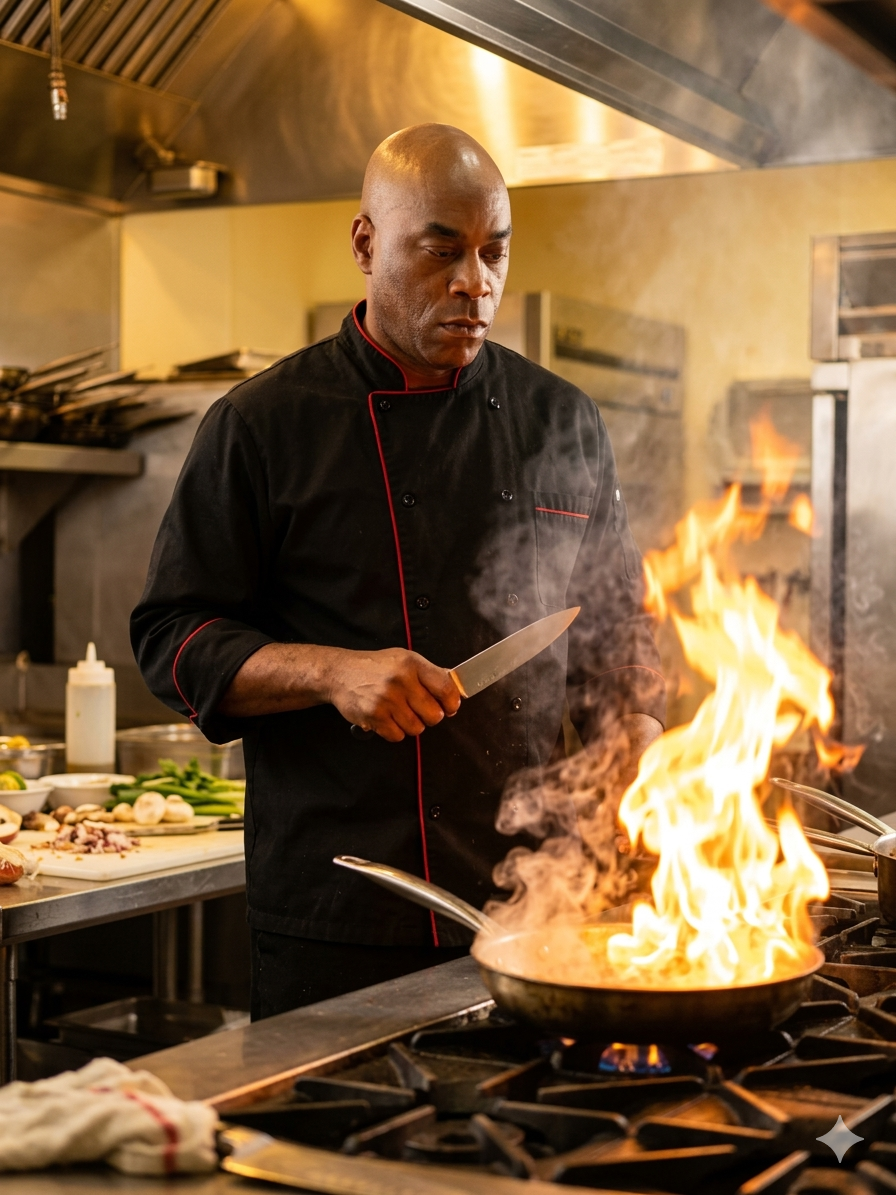
What the Chef Mindset Actually Is
Lesson Objective
Understand that the chef mindset is not a personality type, a title, or a style of communication — it is a specific way of seeing the kitchen as a system, and a specific way of taking responsibility for that system's performance.
Why It Matters
Most cooks think the chef mindset is about authority. They imagine a chef as someone who gives orders, sets standards, and holds people accountable.
That is a partial picture.
The chef mindset is primarily about responsibility. It is the decision to own the outcome — not just your own station, but the kitchen's overall performance. It is the shift from 'I did my part' to 'Did the kitchen succeed?'
This shift is available to any cook at any level. You do not need a title to think like a chef. You need a specific orientation toward the work.
The chef mindset: ownership, accountability, and constant improvement.
The Core Lesson
The chef mindset begins with systems awareness. A cook sees their station. A chef sees the whole kitchen as an interconnected system where every station, every person, every process, and every decision affects every other part. When a cook thinks 'my station is fine,' a chef thinks 'is the kitchen fine?' That is a fundamentally different unit of analysis.
The second component is ownership. A cook completes tasks. A chef owns outcomes. When something goes wrong, a cook may say 'that wasn't my station.' A chef asks 'what could I have done to prevent that, and what do I do now to fix it?' Ownership does not mean blame absorption. It means responsibility orientation — the default question is always 'what can I control or influence here?'
The third component is foresight. A cook responds to what is happening. A chef anticipates what is about to happen. This is the most difficult component to develop because it requires experience, pattern recognition, and the willingness to act before problems become visible. Foresight is what separates reactive cooks from proactive leaders.
The fourth component is communication as a leadership tool. A cook communicates to coordinate. A chef communicates to build shared understanding, maintain alignment, and prevent confusion before it becomes failure. Chef-level communication is not louder — it is more precise, more timely, and more useful to the people receiving it.
The fifth component is standard-setting. A cook meets standards. A chef sets them — not through authority, but through behavior. The cook who always works clean, always communicates clearly, always recovers well, and always holds their station to a high standard is already setting a standard for the room, whether they have the title or not.
Leadership in the kitchen is earned, not assigned.
Example Scenario
Two cooks, same skill level, same station. Cook A thinks: 'My station is running well. I'm doing my job.' Cook B thinks: 'My station is running well. What does the kitchen need from me right now?'
Cook B notices the grill station is getting hammered. Without being asked, they call out their own times clearly so expo can sequence better. They offer to take one item off grill's plate. They communicate proactively.
At the end of service, chef notices Cook B. Not because they were the fastest or the most talented. Because they made the kitchen easier to run.
Rookie Mistakes
- Confusing the chef mindset with authority — it is about responsibility, not rank
- Waiting for the title before thinking like a chef — the mindset comes first, the title follows
- Owning only your station — the chef mindset expands the boundary of responsibility
- Reacting instead of anticipating — foresight is the hardest component to develop
- Communicating only when necessary — chef-level communication is proactive, not reactive
The Professional Standard
The chef mindset is a responsibility orientation, not a personality type
Five components: systems awareness, ownership, foresight, communication as leadership, standard-setting
You do not need a title to think like a chef — the mindset is available at any level
Ownership means: what can I control or influence here? — not blame absorption
Standard-setting through behavior is more powerful than standard-setting through authority
Chef Wisdom
"The chef mindset is not something you get when you get the title. It is something you develop through practice, and the title follows the mindset — not the other way around. The cook who starts thinking like a chef before they are a chef is the cook who becomes one."
— 25 Years in Professional Kitchens
Workbook Reflection
Write your answers below. These are saved automatically in your browser.
Extended Study
The chef mindset can be understood through the lens of what organizational psychologists call 'psychological ownership' — the feeling that something is 'mine' in a psychological sense, even without legal ownership. Research on psychological ownership in workplace settings consistently shows that employees who feel ownership over outcomes perform at higher levels, take more initiative, and are more resilient under pressure.
In kitchen terms, this means the difference between a cook who feels ownership over their station and a cook who feels ownership over the kitchen's success. The latter is the chef mindset. It is not about ego — it is about expanding the boundary of what you feel responsible for.
This expansion is what makes chefs valuable beyond their technical skill. A technically excellent cook who only owns their station is worth one station. A cook who owns the kitchen's success is worth the whole kitchen.
Kitchen Simulation
You are a senior line cook on a Friday night. Your station is running well. But you notice the new cook on the sauté station is falling behind — their mise en place is running low, their timing is off, and they haven't communicated their status to expo. You have three options: 1. Stay focused on your own station — it's not your problem. 2. Shout at them to get it together. 3. Quickly assess what they need, communicate it to expo, and help them stabilize without abandoning your own station. Write what option 3 looks like in practice — the exact words, the exact actions, and the exact sequence. This is the chef mindset in action.
Mastery Questions
Can you answer these without looking back? These are the questions your certification exam will draw from.
- 1What are the five components of the chef mindset, and why is ownership the most important?
- 2What is the difference between 'my station is fine' and 'is the kitchen fine?' — and why does this distinction define the chef mindset?
- 3How does foresight differ from responsiveness — and what does it require to develop?
- 4What is psychological ownership, and how does it explain the difference between a cook and a chef?
- 5How can a cook demonstrate the chef mindset without having the title of chef?
Take It to the Kitchen
For your next three shifts, practice one component of the chef mindset per shift. Shift 1: systems awareness — at least twice during service, stop and ask 'is the kitchen fine?' not just 'is my station fine?' Shift 2: foresight — identify one thing that is about to become a problem before it does, and act on it. Shift 3: standard-setting through behavior — pick one standard and hold it visibly throughout the shift. Write what you observed after each shift.
YouTube: 'The Chef Mindset — What No One Teaches You About Kitchen Leadership' | Textbook Chapter: The Psychology of Kitchen Leadership | Certification Module: Leadership Readiness Assessment | Simulation: Multi-station coordination exercise | Case Study: How a line cook's ownership mindset prevented a service collapse