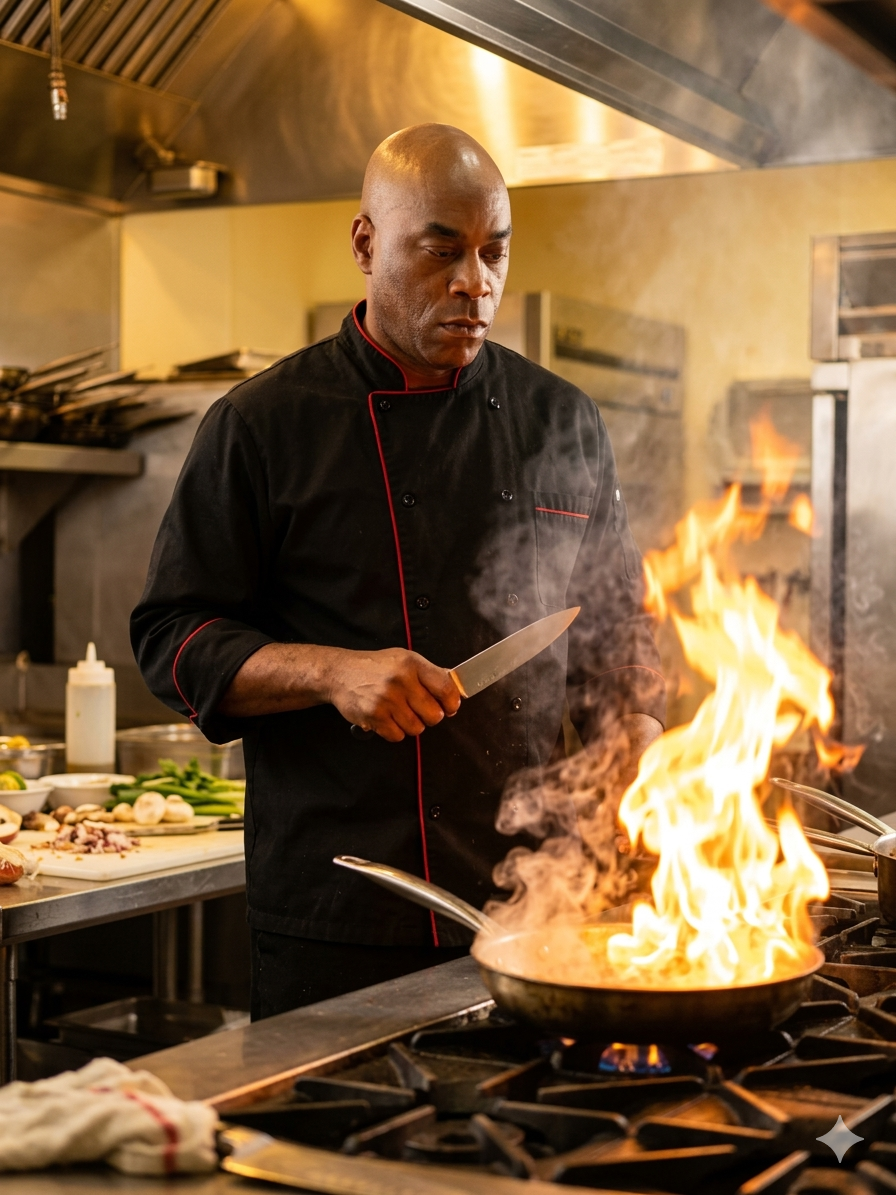
Decision-Making Under Pressure
Lesson Objective
Develop a reliable decision-making framework for high-pressure kitchen situations — one that produces good decisions quickly without requiring perfect information or perfect conditions.
Why It Matters
Kitchens are decision-rich environments. During a busy service, a line cook may make dozens of micro-decisions every hour: what to fire next, how to sequence proteins, when to call for backup, whether to push through or communicate a problem.
Most of these decisions happen in seconds, under pressure, with incomplete information.
The quality of these decisions determines the quality of the service. And the quality of these decisions is not random — it can be trained.
The chef mindset: ownership, accountability, and constant improvement.
The Core Lesson
Decision-making under pressure is different from decision-making in calm conditions. Under pressure, the brain's prefrontal cortex — responsible for complex reasoning — becomes less dominant, while the amygdala — responsible for threat response — becomes more active. This is why people under pressure often make decisions that feel right in the moment but are clearly wrong in retrospect. The pressure response is not a character flaw. It is a biological reality that can be managed through training and preparation.
The most effective kitchen decision-making framework has three components: triage, sequence, and communicate. Triage means identifying the most urgent problem first — not the most visible problem, not the most emotionally charged problem, but the one with the highest consequence if not addressed immediately. Sequence means ordering your responses so that each action creates the best conditions for the next. Communicate means making your decision visible to the people who need to know about it.
One of the most important decision-making skills in kitchens is knowing when NOT to decide. During active service, some decisions should be deferred — not because they don't matter, but because acting on incomplete information under maximum pressure often produces worse outcomes than waiting 30 seconds for clarity. The cook who can pause, assess, and then act is usually more effective than the cook who acts immediately on instinct.
Pattern recognition is the most powerful decision-making tool available to experienced cooks. When you have seen a situation many times, your brain can recognize patterns and generate good responses without conscious deliberation. This is what experienced cooks call 'reading the service' — the ability to sense what is about to happen and respond before it does. Pattern recognition is built through deliberate practice and reflection, not just time spent in kitchens.
The final component is post-decision learning. After every service, the chef mindset asks: which decisions were good, which were poor, and what made the difference? This reflection is what converts experience into wisdom. Without it, a cook can spend ten years in kitchens and still make the same poor decisions under pressure.
Leadership in the kitchen is earned, not assigned.
Example Scenario
Two cooks face the same situation: tickets stacking, one station behind, expo calling for a pickup. Cook A makes an immediate decision based on the most visible problem — the expo call. They abandon their sequence to rush a pickup, which causes two other tickets to fall behind.
Cook B pauses for 3 seconds, triages (the most urgent problem is the station falling behind, not the expo call), sequences their response (stabilize the station first, then address expo with an honest time), and communicates (calls out their situation to chef). The service recovers.
Rookie Mistakes
- Acting on the most visible problem instead of the most urgent one
- Making decisions under maximum pressure without pausing to assess
- Not communicating decisions to the people who need to know
- Confusing movement with good decision-making
- Not reflecting after service — missing the learning opportunity
The Professional Standard
The decision-making framework: triage, sequence, communicate
Pattern recognition is built through deliberate practice and reflection
Know when NOT to decide — sometimes a 3-second pause produces better outcomes
Post-decision reflection is what converts experience into wisdom
Good decisions under pressure are trained, not innate
Chef Wisdom
"The best kitchen decision-makers are not the fastest. They are the most accurate. Speed without accuracy is just fast mistakes. The goal is to develop the pattern recognition that makes accurate decisions fast."
— 25 Years in Professional Kitchens
Workbook Reflection
Write your answers below. These are saved automatically in your browser.
Extended Study
The science of decision-making under pressure draws on research from cognitive psychology, military training, and emergency medicine. Gary Klein's Recognition-Primed Decision (RPD) model, developed through studies of firefighters and military commanders, found that experienced decision-makers rarely use formal analytical processes under pressure. Instead, they use pattern recognition to identify the situation type, mentally simulate the first plausible option, and act if the simulation suggests it will work.
This research has profound implications for kitchen training. It suggests that the most effective way to improve kitchen decision-making is not to teach formal decision frameworks (though these are useful for reflection) but to build pattern libraries through deliberate practice — exposing cooks to a wide range of service scenarios so their brains can develop the pattern recognition needed for fast, accurate decisions under pressure.
Kitchen Simulation
You are on the grill station during a Friday dinner rush. At 7:15 PM, you have: 4 steaks at various temperatures on the grill, 2 tickets just fired with 3 steaks each, a sauté cook asking for your timing on a protein they're waiting for, and expo calling for a pickup on a table that's been waiting 8 minutes. Write your triage, sequence, and communication decisions in order. What do you address first, second, third? What do you say, to whom, and when? This is decision-making under pressure — practiced before you need it.
Mastery Quiz
Test yourself before revealing answers. These questions come directly from your certification exam.
Take It to the Kitchen
After your next three shifts, write down one decision you made under pressure — what the situation was, what you decided, what the outcome was, and what you would decide differently with hindsight. This is the reflection practice that builds decision-making wisdom.
YouTube: 'How to Make Better Decisions Under Pressure in the Kitchen' | Textbook Chapter: The Cognitive Science of Kitchen Decision-Making | Certification Module: Decision Quality Assessment | Simulation: Multi-scenario triage exercise | Case Study: How a decision-making protocol change improved service consistency