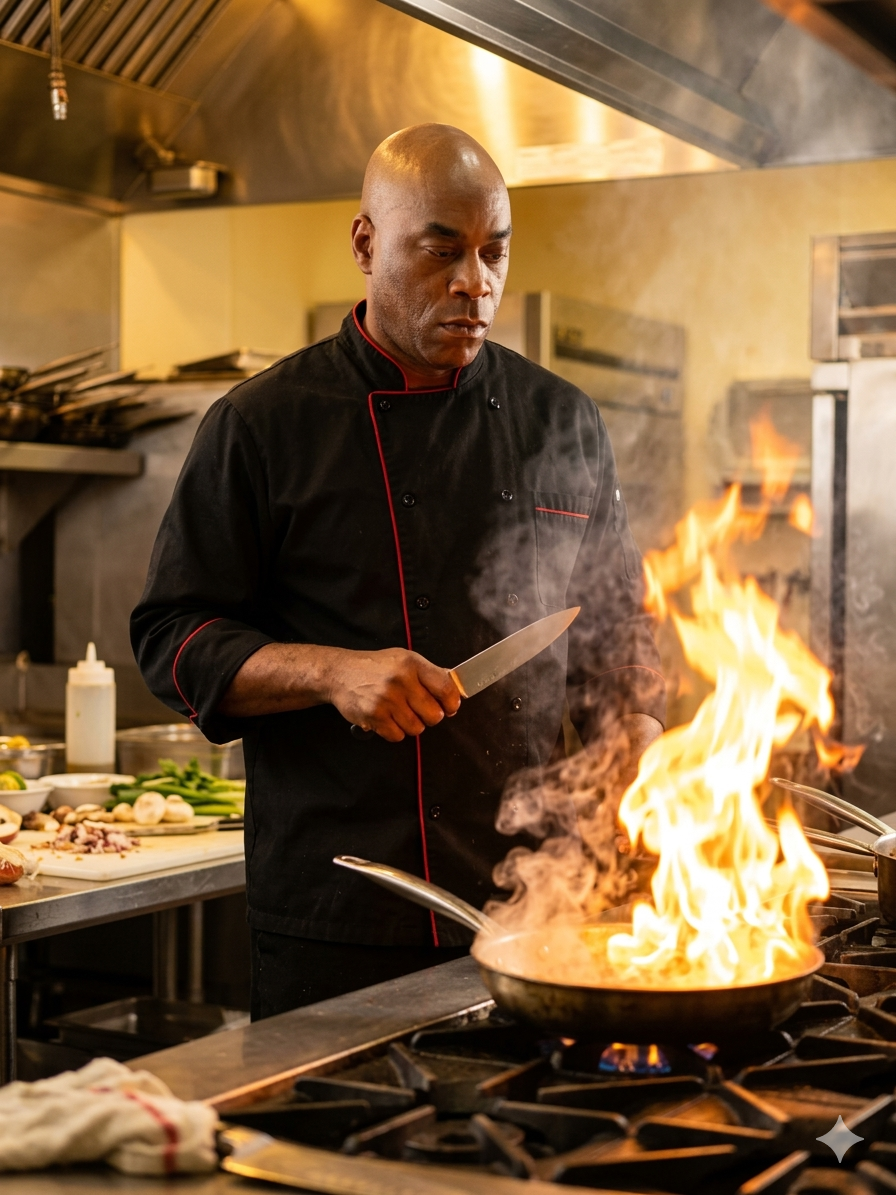
Building and Maintaining Standards
Lesson Objective
Understand how professional kitchen standards are built, maintained, and enforced — and develop the ability to hold standards through behavior rather than authority.
Why It Matters
Standards are what separate professional kitchens from amateur ones. Not talent. Not equipment. Not recipes.
Standards.
A standard is a defined level of performance that is expected consistently, regardless of who is working, what day it is, or how busy the service is. Standards create predictability. Predictability creates trust. Trust creates the conditions for excellence.
The challenge is that standards are easy to define and hard to maintain. Every kitchen has written standards. The question is whether those standards are actually lived.
The chef mindset: ownership, accountability, and constant improvement.
The Core Lesson
Standards exist at three levels in professional kitchens. Technical standards define the quality of the food: temperature, texture, presentation, portion size, flavor profile. Operational standards define how the work is done: mise en place completeness, station organization, communication protocols, cleaning procedures. Behavioral standards define how people operate in the room: respect, honesty, coachability, reliability under pressure. All three levels must be maintained for a kitchen to function at a professional level.
The most common failure mode for standards is gradual erosion. A standard is set. Then one exception is made — a busy night, a short-staffed shift, a small compromise. Then another exception. Then the exception becomes the norm. Then the original standard is forgotten. This process is called standards drift, and it happens in every kitchen that does not actively resist it.
Standards are maintained through three mechanisms: modeling, correction, and accountability. Modeling means the leader holds the standard visibly through their own behavior. Correction means addressing deviations from the standard immediately and specifically — not generally, not later, not through passive disapproval. Accountability means there are consistent consequences for repeated standard violations, and consistent recognition for standard excellence.
The most powerful standard-maintenance tool is not authority — it is clarity. When everyone in the kitchen knows exactly what the standard is, why it exists, and what it looks like in practice, maintaining it becomes a shared responsibility rather than a management burden. This is why the best kitchen leaders spend time explaining standards, not just enforcing them.
For cooks who do not yet have authority, standard-setting through behavior is the most available tool. The cook who always works clean, always communicates clearly, always recovers well, and always holds their station to a high standard is already setting a standard for the room. Other cooks notice. Leadership notices. Standards are contagious — both upward and downward.

Leadership in the kitchen is earned, not assigned.
Example Scenario
A kitchen has a standard: all proteins are labeled and dated before going into the walk-in. For six months, this standard is maintained perfectly. Then one busy night, a cook skips the labeling to save time. Nothing bad happens. The next week, two cooks skip it. Within a month, labeling is inconsistent. Within three months, it has stopped entirely.
This is standards drift. It did not happen because the standard was bad. It happened because one exception was allowed, and the exception became the norm.
Rookie Mistakes
- Allowing one exception to a standard without addressing it
- Enforcing standards through authority instead of clarity and modeling
- Not explaining why a standard exists — compliance without understanding is fragile
- Waiting for leadership to enforce standards instead of modeling them yourself
- Not recognizing standards drift until it has become the new norm
The Professional Standard
Standards exist at three levels: technical, operational, behavioral
Standards drift is the most common failure mode — resist it actively
Maintain standards through modeling, correction, and accountability
Clarity is more powerful than authority for standards maintenance
Standards are contagious — your visible behavior sets the standard for the room
Chef Wisdom
"A kitchen's standards are not what is written on the wall. They are what is tolerated on the floor. The gap between the two is where kitchens fail."
— 25 Years in Professional Kitchens
Workbook Reflection
Write your answers below. These are saved automatically in your browser.
Extended Study
The psychology of standards maintenance draws on research in behavioral consistency and social norms. Robert Cialdini's work on social proof demonstrates that people look to others' behavior to determine what is appropriate in a given situation. In kitchen terms, this means that the visible behavior of senior cooks sets the standard for the entire room — whether intentionally or not.
This has a powerful implication: the most effective way to raise kitchen standards is not to post new rules or give new speeches. It is to change the visible behavior of the most influential people in the room. When senior cooks work clean, junior cooks work clean. When senior cooks communicate clearly, junior cooks learn to communicate clearly. Standards are socially transmitted through behavior.
Kitchen Simulation
You are a senior line cook. You notice that the station next to you has been consistently leaving mise en place containers uncovered at the end of prep. It has happened three shifts in a row. The cook responsible is newer and seems unaware of the standard. Write how you address this: what you say, when you say it, how you frame it, and what outcome you are trying to create. This is standard-setting through behavior and communication — not authority.
Mastery Quiz
Test yourself before revealing answers. These questions come directly from your certification exam.
Take It to the Kitchen
Identify one standard in your kitchen that has drifted from its original level. Write: what the original standard was, what the current practice is, what caused the drift, and what specific behavior change would restore the standard. Then practice that behavior change for one week.
YouTube: 'How Standards Are Really Maintained in Professional Kitchens' | Textbook Chapter: Standards Architecture and Maintenance Systems | Certification Module: Standards Assessment | Simulation: Standards drift identification exercise | Case Study: How one kitchen restored its standards after a period of decline