Systems Thinking in the Kitchen
Lesson Objective
Develop the ability to see the kitchen as an interconnected system — where every decision, every station, and every person affects every other part — and use this understanding to make better operational decisions.
Why It Matters
Most cooks see the kitchen in parts. They see their station, their tickets, their mise en place, their timing.
Chefs see the kitchen as a whole. They see how the prep cook's decisions affect the line cook's speed. How the dishwasher's pace affects the expo's ability to plate. How one station's communication failure creates a cascade of delays across the entire service.
This whole-system view is what makes the difference between a cook who is good at their station and a chef who can run a kitchen.
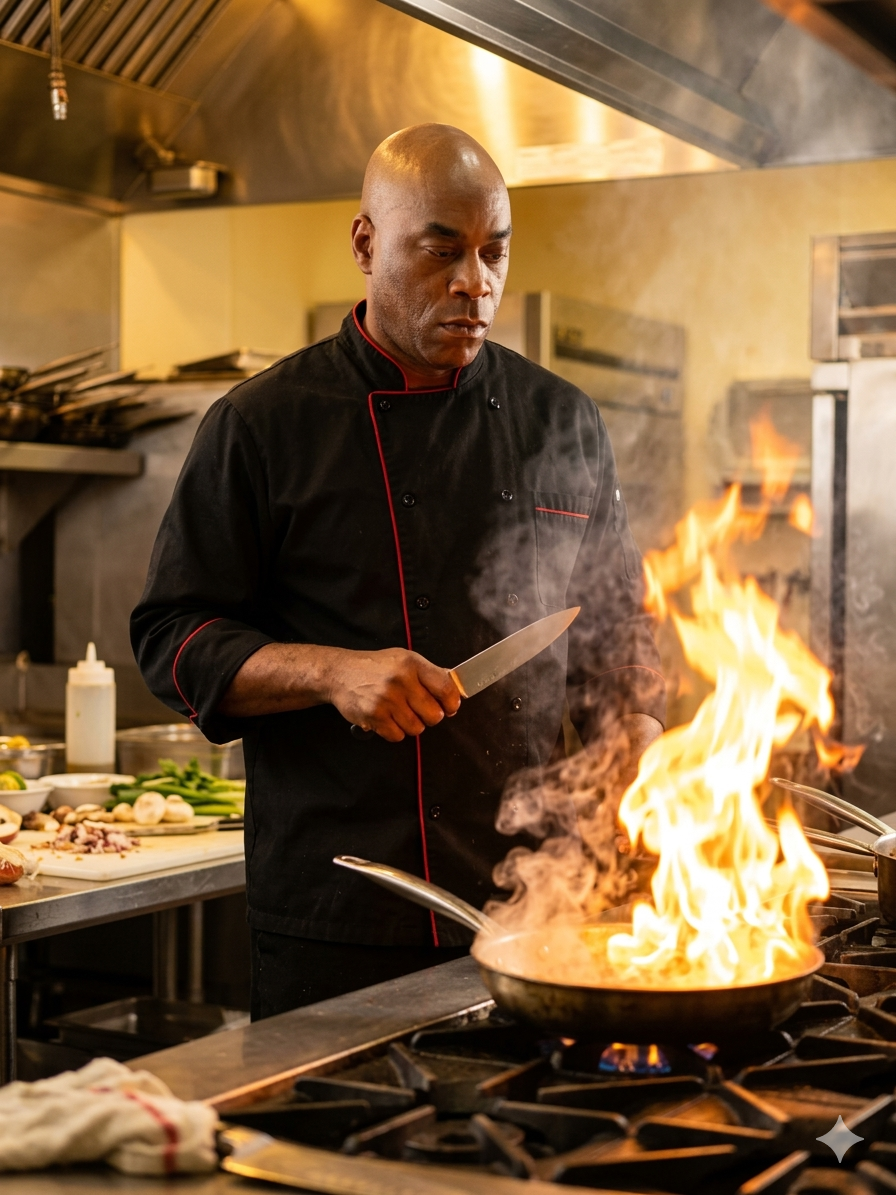
The chef mindset: ownership, accountability, and constant improvement.
The Core Lesson
A system is a set of interconnected parts that work together to produce an outcome. A kitchen is one of the most complex operational systems in the service industry. It combines human performance, physical equipment, ingredient quality, time pressure, communication flow, and customer demand — all simultaneously, all in real time.
Systems thinking means understanding that changes in one part of the system affect other parts. When the prep cook under-portions proteins, the line cook runs out mid-service. When the line cook doesn't call times, expo can't sequence plates. When expo can't sequence plates, the server delivers cold food. When the server delivers cold food, the customer complains. One decision at the beginning of the chain creates a problem at the end.
The most powerful application of systems thinking in kitchens is identifying leverage points — the places where a small change produces a large improvement. In most kitchens, the highest leverage points are communication clarity, mise en place completeness, and transition management (the moments between prep and service, and between service and close). Improving these three areas consistently produces better results than improving any single technical skill.
Systems thinking also means understanding feedback loops. A positive feedback loop in a kitchen: a cook communicates clearly → expo sequences better → plates go out faster → chef notices and trusts the cook more → cook gets more responsibility → cook communicates even more clearly. A negative feedback loop: a cook doesn't communicate → expo guesses → plates go out wrong → chef loses trust → cook gets less responsibility → cook communicates even less.
The practical skill is learning to trace problems back to their source rather than reacting to symptoms. When a station collapses during service, the instinct is to fix the station. The systems thinker asks: what was the upstream decision that created this downstream problem? That question leads to real solutions instead of repeated firefighting.
Leadership in the kitchen is earned, not assigned.
Example Scenario
A restaurant has a recurring problem: the grill station consistently falls behind during the 7 PM rush. The chef's first instinct is to hire a faster grill cook. But a systems thinker asks: why does the grill station fall behind at 7 PM specifically?
Investigation reveals: the prep cook finishes proteins at 4 PM. The grill cook doesn't set up until 5 PM. Between 4 and 5, proteins sit without proper temperature management. By 7 PM, the grill cook is working with inconsistently tempered proteins that cook unevenly, requiring more attention per steak.
The fix is not a faster grill cook. The fix is a protocol change: proteins are staged and tempered at 4:30 PM, 30 minutes before the grill cook sets up. The 7 PM problem disappears.
Rookie Mistakes
- Seeing only your station instead of the whole kitchen system
- Reacting to symptoms instead of tracing problems to their source
- Not understanding how your decisions affect other stations
- Ignoring feedback loops — both positive and negative
- Fixing the wrong thing because you didn't do root cause analysis
The Professional Standard
See the kitchen as an interconnected system — every decision affects every other part
Identify leverage points: communication clarity, mise en place completeness, transition management
Trace problems upstream: what was the decision that created this outcome?
Understand feedback loops — build positive ones, break negative ones
Systems thinking is the foundation of kitchen leadership
Chef Wisdom
"Cooks fix problems. Chefs fix systems. The difference is whether you are solving the same problem repeatedly or building the conditions that prevent it from occurring."
— 25 Years in Professional Kitchens
Workbook Reflection
Write your answers below. These are saved automatically in your browser.
Extended Study
Systems thinking as a formal discipline was developed by Jay Forrester at MIT in the 1950s and popularized by Peter Senge in 'The Fifth Discipline' (1990). Senge identified five disciplines of learning organizations, with systems thinking as the cornerstone. His central insight was that most organizational problems are not caused by bad people or bad intentions — they are caused by system structures that produce predictable patterns of behavior.
In kitchen terms, this means that many service failures are not caused by lazy or incompetent cooks — they are caused by system structures that make failure predictable. Poor communication systems, inadequate mise en place standards, unclear role boundaries, and weak transition protocols all create conditions where failure is the natural outcome regardless of individual effort.
The chef who understands systems thinking can redesign these structures — creating conditions where success is the natural outcome.
Kitchen Simulation
Map a service failure you have witnessed or experienced. Start with the visible problem (e.g., 'three tables received cold food at the same time'). Work backward through the system: What was the immediate cause? What was the upstream cause of that? What was the structural condition that made that upstream cause likely? What could have been changed at the structural level to prevent the whole chain? This exercise teaches root cause analysis — the most valuable diagnostic skill in kitchen operations.
Mastery Quiz
Test yourself before revealing answers. These questions come directly from your certification exam.
Take It to the Kitchen
For your next shift, practice tracing one problem back to its source. When something goes wrong — a ticket gets missed, a station falls behind, communication breaks down — resist the instinct to fix the symptom. Instead, ask: what was the upstream decision or condition that created this? Write your analysis after the shift.
YouTube: 'Why Kitchens Fail — A Systems Analysis' | Textbook Chapter: Kitchen Systems and Operational Design | Certification Module: Systems Diagnosis Assessment | Simulation: Trace a service failure through five upstream causes | Case Study: How one communication system change reduced service failures by 40%