The Complete Professional: Bringing It All Together
Lesson Objective
Integrate all ten modules of the Line Cook Survival System into a coherent professional identity — understanding how each component reinforces the others and what it means to be a complete professional in a modern kitchen.
Why It Matters
You have covered ten modules. One hundred lessons. Thousands of concepts, frameworks, and principles.
Now the question is: what does it all add up to?
The answer is a complete professional. Not perfect. Not finished. But complete — meaning you have the foundation, the systems, the mindset, and the self-awareness to continue developing for the rest of your career.
This final lesson is about integration: understanding how everything connects, and what kind of cook you are committing to become.
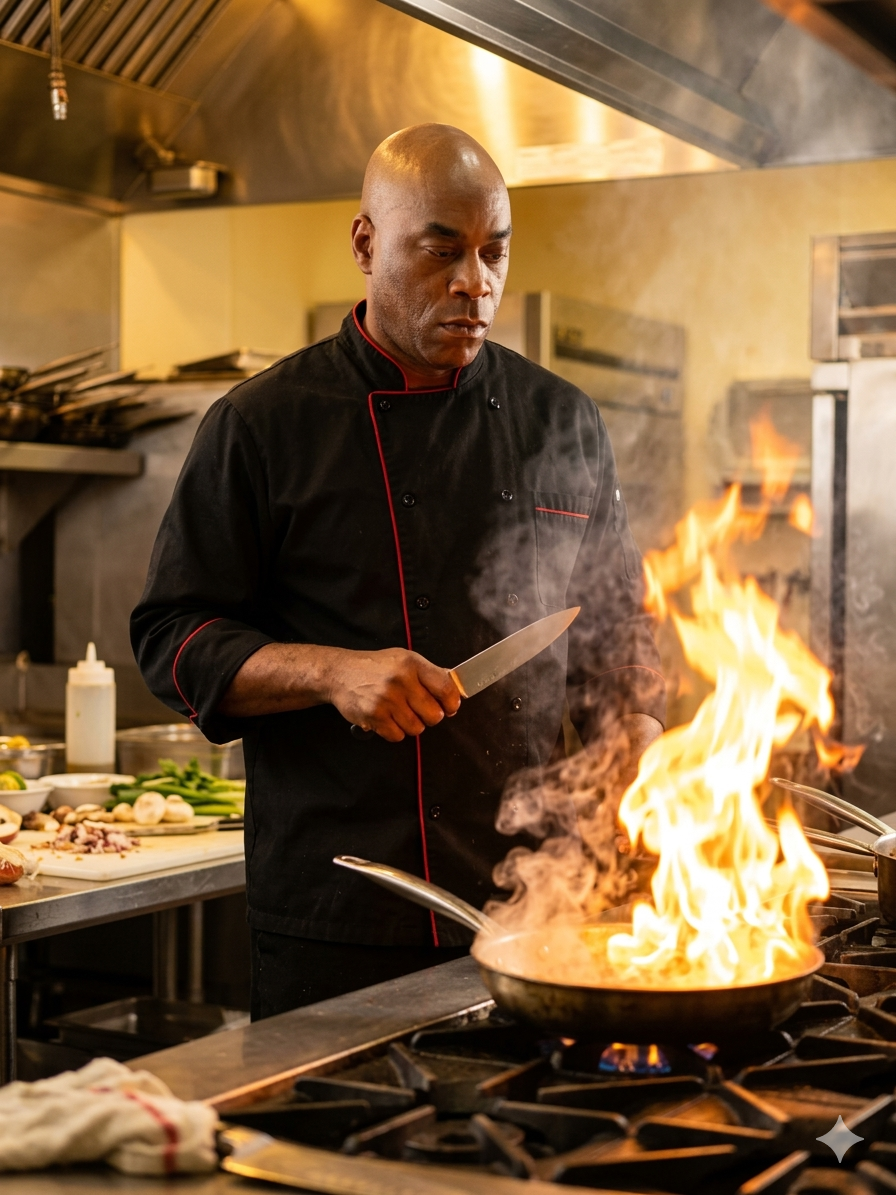
The chef mindset: ownership, accountability, and constant improvement.
The Core Lesson
The ten modules of this course are not ten separate topics. They are ten dimensions of a single professional identity. Kitchen reality (Module 1) provides the foundation of accurate perception. First day survival (Module 2) builds the habits of professional entry. Mise en place (Module 3) creates the operational discipline that everything else depends on. Working the line (Module 4) develops the execution skills of real service. Surviving the rush (Module 5) builds the pressure resilience that separates professionals from amateurs.
Station ownership (Module 6) develops the ownership orientation that is the precursor to leadership. Kitchen discipline (Module 7) builds the internal standards that make performance consistent. Thinking like a chef (Module 8) develops the analytical capabilities of professional judgment. Kitchen politics (Module 9) builds the social and political intelligence to navigate complex human systems. The chef mindset (Module 10) integrates everything into a coherent professional orientation.
The complete professional is not defined by any single skill or quality. They are defined by the integration of all of them: technical excellence, operational discipline, communication clarity, pressure resilience, ownership orientation, analytical capability, social intelligence, and professional identity. This integration is what makes someone genuinely valuable in a professional kitchen — not just good at one thing, but reliable across all dimensions.
Professional development is not a destination — it is a practice. The cook who completes this course has not arrived. They have built a foundation and a framework for continued development. The most important thing this course can give you is not a set of skills, but a way of approaching your own development: with honesty, with intention, with patience, and with the understanding that excellence is built through consistent practice over time.
The final commitment of the complete professional is to the kitchen itself — to the tradition of craft, to the development of the people around you, and to the standard of excellence that makes professional cooking worth doing. This commitment is what separates the cook who works in kitchens from the cook who belongs to the kitchen. It is the difference between a job and a vocation.
Leadership in the kitchen is earned, not assigned.
Example Scenario
Two cooks complete the same training program. Cook A has learned the techniques and can execute them when reminded. Cook B has integrated the principles into their professional identity — they don't need to be reminded because the standards are part of who they are.
Two years later, Cook A is still a good line cook. Cook B is a sous chef. The difference is not talent. It is integration — the depth to which the professional identity has been internalized.
Rookie Mistakes
- Treating the course as a checklist instead of a foundation
- Thinking development ends when the course ends
- Not integrating the modules — seeing them as separate topics instead of dimensions of one identity
- Not making the professional commitment explicit — identity requires commitment, not just knowledge
- Confusing knowing with being — the goal is not to know these things, but to be them
The Professional Standard
The ten modules are ten dimensions of one professional identity — not ten separate topics
The complete professional: technical excellence, operational discipline, communication clarity, pressure resilience, ownership orientation, analytical capability, social intelligence, professional identity
Professional development is a practice, not a destination
Professional identity is the most important psychological resource in high-stress occupations
The difference between working in kitchens and belonging to the kitchen is commitment
Chef Wisdom
"You do not become a complete professional by finishing a course. You become one by committing to a standard of excellence and practicing it every day for the rest of your career. The course gives you the map. The commitment is yours."
— 25 Years in Professional Kitchens
Workbook Reflection
Write your answers below. These are saved automatically in your browser.
Extended Study
The concept of professional identity — a stable, coherent sense of who you are as a professional — is one of the most important psychological resources available to kitchen workers. Research on professional identity in high-stress occupations consistently shows that workers with strong professional identity are more resilient under pressure, more committed to quality standards, more resistant to burnout, and more likely to continue developing throughout their careers.
Building professional identity in kitchens requires three things: a clear understanding of what the profession demands (which this course has provided), a set of skills and habits that meet those demands (which this course has developed), and a commitment to the values that define professional excellence (which this final lesson asks you to make explicitly).
Kitchen Simulation
Write your professional identity statement: who you are as a kitchen professional, what you stand for, what standards you hold, and what kind of cook you are committed to becoming. This is not a resume statement — it is a personal commitment. Write it in first person, in your own voice, and be specific. Then share it with one person you respect and ask them to hold you accountable to it.
Mastery Quiz
Test yourself before revealing answers. These questions come directly from your certification exam.
Take It to the Kitchen
Write your professional identity statement. Post it somewhere you will see it before every shift. Review it monthly and update it as you develop. This is the living document of who you are committed to becoming.
YouTube: 'What It Means to Be a Complete Kitchen Professional' | Textbook Chapter: Integration and Professional Identity | Certification Exam: Full 100-question assessment across all ten modules | Simulation: Complete professional self-assessment | Case Study: The career trajectory of a complete professional
Module 10 Complete
Module 10 completes the Line Cook Survival System by developing the chef mindset — the integration of all previous modules into a coherent professional identity. By the end of this module, the student should be able to think in systems, make better decisions under pressure, build and maintain standards, teach effectively, manage their own development, read and influence kitchen culture, understand the business of the kitchen, build a career with intention, and commit to the professional identity of a complete kitchen professional.