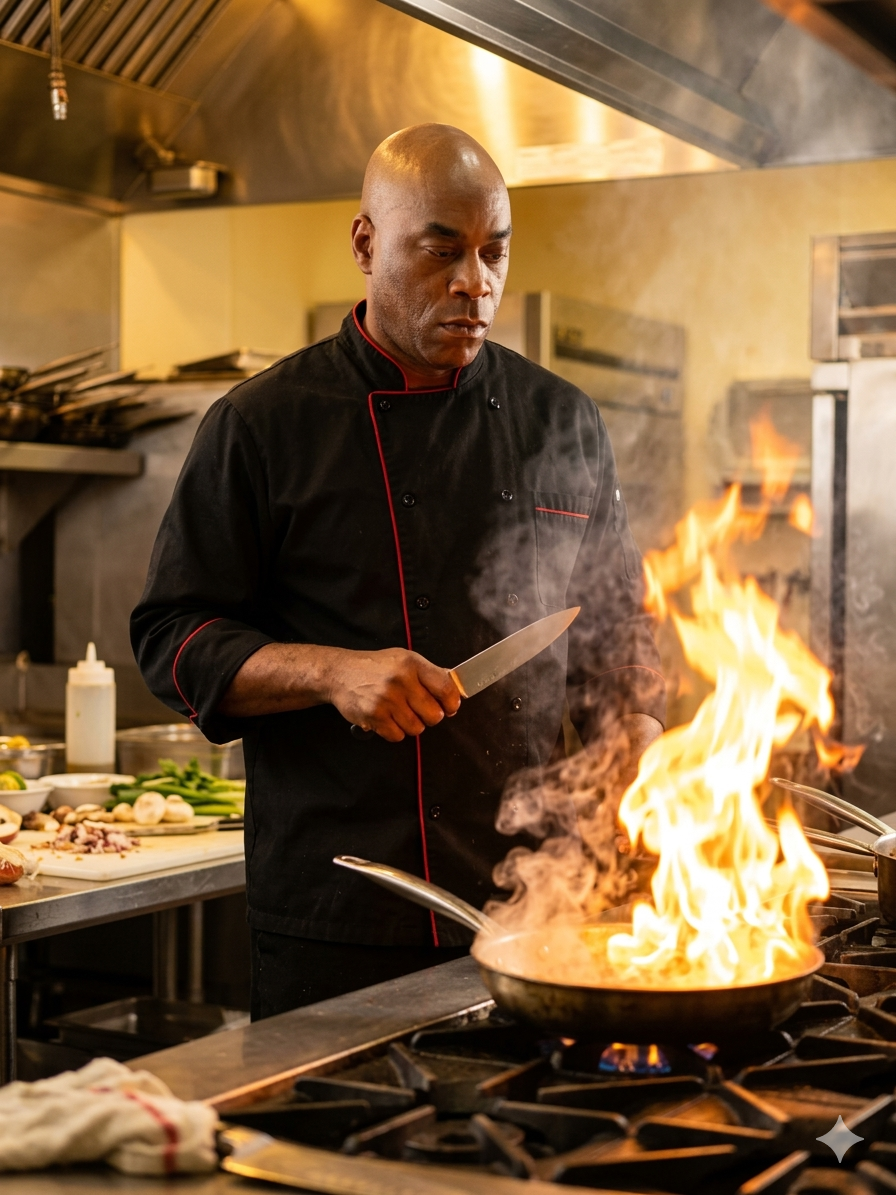
Managing Your Own Development
Lesson Objective
Develop a systematic approach to managing your own professional development — understanding that career growth in kitchens is not accidental, it is engineered.
Why It Matters
Most cooks develop by accident. They work in kitchens, things happen, they absorb some of it, and over time they get better. This works, but it is slow and incomplete.
The cook who manages their own development deliberately gets better faster, fills gaps more completely, and builds a more coherent skill set than the cook who just shows up and hopes for the best.
In a competitive industry, the difference between accidental development and deliberate development is often the difference between a cook and a chef.
The chef mindset: ownership, accountability, and constant improvement.
The Core Lesson
Deliberate development begins with honest self-assessment. A cook must be able to identify their actual skill level — not their aspirational skill level, not their self-image, but their real operational capability under pressure. This requires the willingness to see weaknesses clearly, which is uncomfortable but essential. The cook who cannot see their own gaps cannot close them.
Once gaps are identified, the next step is prioritization. Not all gaps are equally important. Some gaps are critical — they limit performance in ways that are visible and costly. Some gaps are developmental — they limit advancement but not current performance. Some gaps are aspirational — they are nice to have but not urgent. Effective self-development focuses on critical gaps first.
The most powerful development tool available to cooks is deliberate practice in real kitchen conditions. This means identifying a specific skill to develop, designing practice that pushes just beyond current ability, seeking feedback on performance, and reflecting on what worked and what didn't. This is not the same as just working more shifts. It is working with specific developmental intention.
Mentorship is the highest-leverage development tool available. A mentor who has already developed the skills you are trying to build can compress years of learning into months by providing targeted feedback, sharing pattern recognition, and helping you avoid the most costly mistakes. Finding and cultivating mentorship relationships is one of the most important career investments a cook can make.
Development also requires managing the relationship between comfort and growth. Skills develop at the edge of current ability — not in the comfort zone, and not in the panic zone. The cook who only does what they are already good at stops developing. The cook who is constantly overwhelmed cannot learn effectively. The goal is to find and stay at the productive edge: challenging enough to require growth, manageable enough to allow learning.
Leadership in the kitchen is earned, not assigned.
Example Scenario
Two cooks start at the same restaurant on the same day with similar skill levels. After two years, Cook A has improved modestly. Cook B has been promoted to sous chef.
The difference: Cook B kept a development journal, sought feedback after every service, identified specific gaps and designed practice to close them, found a mentor, and deliberately sought out the most challenging stations. Cook A just showed up and worked hard.
Hard work is necessary. Deliberate development is what makes it sufficient.
Rookie Mistakes
- Developing by accident instead of by design
- Not being able to see your own gaps honestly
- Practicing what you are already good at instead of what you need to develop
- Not seeking feedback — feedback is the fuel of development
- Staying in the comfort zone — skills develop at the edge of current ability
The Professional Standard
Deliberate development: honest self-assessment, gap prioritization, deliberate practice, feedback, reflection
Critical gaps first — not all gaps are equally important
Mentorship is the highest-leverage development tool available
The productive edge: challenging enough to require growth, manageable enough to allow learning
Growth mindset: see challenges as learning opportunities, not threats to self-image
Chef Wisdom
"Your career is something you build deliberately, or it builds itself without you. The cook who engineers their own development moves faster, further, and with more satisfaction than the cook who just shows up and hopes for the best."
— 25 Years in Professional Kitchens
Workbook Reflection
Write your answers below. These are saved automatically in your browser.
Extended Study
Carol Dweck's research on growth mindset versus fixed mindset has profound implications for kitchen development. Dweck found that people with a growth mindset — who believe abilities can be developed through effort and learning — consistently outperform people with a fixed mindset — who believe abilities are innate and fixed — in challenging environments.
In kitchen terms, a growth mindset cook sees a difficult service as a learning opportunity. A fixed mindset cook sees it as a threat to their self-image. A growth mindset cook welcomes correction because it accelerates development. A fixed mindset cook resists correction because it feels like an attack on their identity.
The good news is that mindset is not fixed. It can be deliberately cultivated through the language you use about your own performance, the way you interpret challenges, and the habits you build around learning and reflection.
Kitchen Simulation
Conduct a self-assessment of your current skill level across five categories: technical execution, mise en place discipline, communication under pressure, recovery from mistakes, and systems awareness. Rate yourself honestly on each (1-5). Identify your two lowest scores. Write a specific 30-day development plan for one of them: what you will practice, how often, what feedback you will seek, and how you will measure improvement.
Mastery Quiz
Test yourself before revealing answers. These questions come directly from your certification exam.
Take It to the Kitchen
Write your personal development plan for the next 90 days. Include: your honest self-assessment across five skill categories, your top two critical gaps, your specific practice plan for each, the feedback sources you will use, and how you will measure progress.
YouTube: 'How to Develop Faster as a Cook — The Deliberate Practice Method' | Textbook Chapter: Engineering Your Own Kitchen Career | Certification Module: Development Planning Assessment | Simulation: 90-day development plan exercise | Case Study: How a deliberate development approach accelerated one cook's career by 3 years