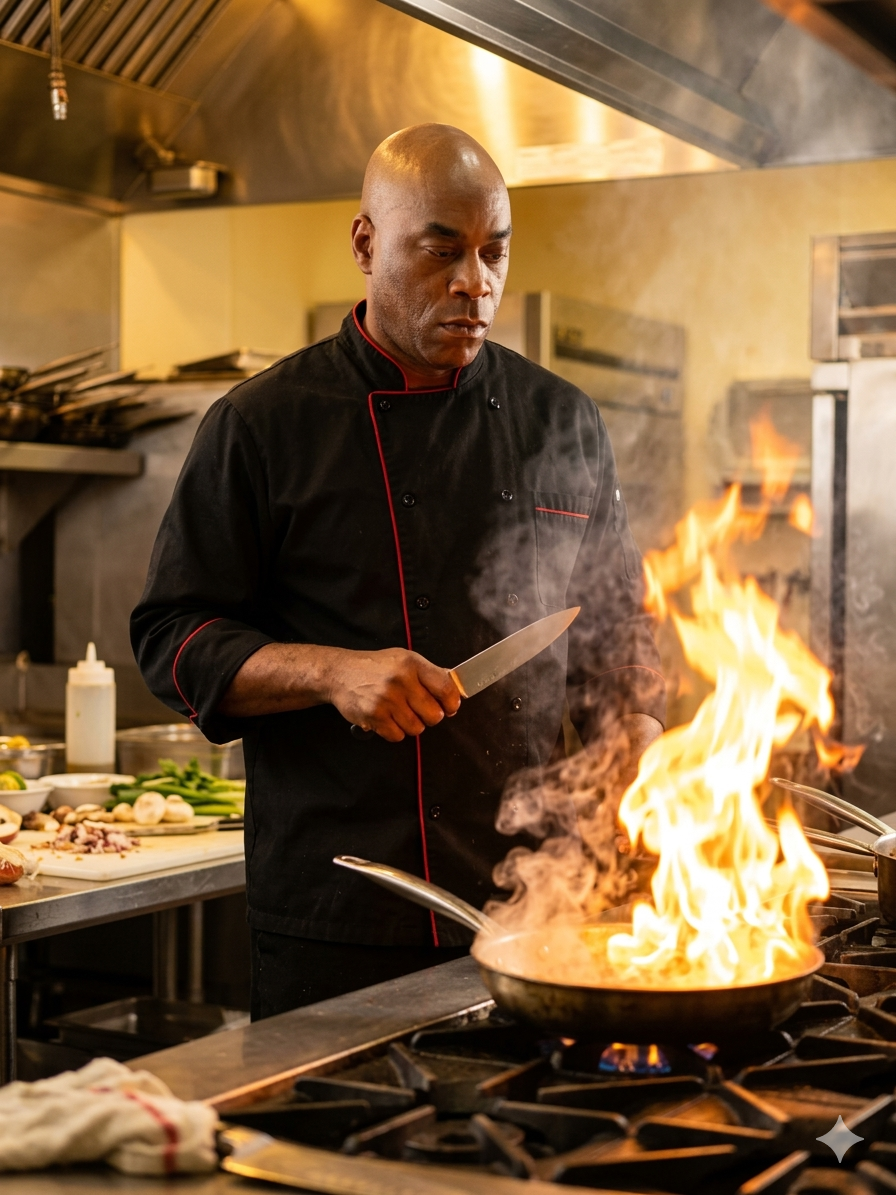
Mentoring and Teaching in the Kitchen
Lesson Objective
Develop the ability to teach kitchen skills effectively — understanding that teaching is not just explaining, but creating the conditions for genuine skill development in another person.
Why It Matters
Every experienced cook has knowledge that newer cooks need. The question is whether that knowledge gets transferred effectively.
In most kitchens, knowledge transfer is inefficient. Senior cooks show something once, assume the newer cook got it, and move on. When the newer cook makes the same mistake again, the senior cook gets frustrated. The newer cook feels like a failure. The kitchen loses productivity.
This cycle is not inevitable. It is the result of poor teaching, not poor learning.
The chef mindset: ownership, accountability, and constant improvement.
The Core Lesson
Effective kitchen teaching has four components: demonstration, explanation, supervised practice, and feedback. Demonstration shows the skill in real time. Explanation provides the reasoning behind the skill — not just what to do, but why. Supervised practice allows the learner to attempt the skill with support available. Feedback closes the loop by identifying what was done well and what needs adjustment. Most kitchen teaching skips explanation and supervised practice, which is why most kitchen teaching is ineffective.
The most important teaching insight is that understanding and ability are different things. A cook can understand a concept completely and still be unable to execute it under pressure. This is because skill execution requires not just knowledge but muscle memory, pattern recognition, and stress tolerance — all of which are built through repetition, not explanation. Effective teachers understand this and design practice opportunities accordingly.
Teaching exposes the quality of your own thinking. When you try to explain something you do intuitively, you often discover that your understanding is less complete than you thought. This is why teaching is one of the most powerful learning tools available. The act of explaining forces you to articulate what you know, which reveals gaps in your own understanding and deepens your mastery.
The emotional dimension of teaching is often overlooked. Learning new skills under pressure is stressful. Learners who feel judged, rushed, or humiliated learn more slowly and retain less. Learners who feel supported, respected, and given appropriate challenge learn faster and retain more. This is not about being soft — it is about being effective. The teacher who creates psychological safety for learning gets better results than the teacher who creates fear.
The best kitchen teachers share three qualities: patience with the learning process (not with repeated carelessness), specificity in feedback (not 'that's wrong' but 'here's exactly what needs to change and why'), and genuine investment in the learner's development (not just in their own performance).
Leadership in the kitchen is earned, not assigned.
Example Scenario
A senior cook shows a new cook how to break down a chicken. They do it once, quickly, without explanation. 'Got it?' 'Yes chef.' The next day, the new cook breaks down three chickens incorrectly, wasting significant product.
The senior cook is frustrated. But the failure was in the teaching, not the learning. No explanation of why each cut matters. No supervised practice. No feedback loop. The new cook was set up to fail.
Rookie Mistakes
- Showing something once and assuming the learner got it
- Teaching what to do without explaining why — compliance without understanding is fragile
- Skipping supervised practice — understanding is not ability
- Giving vague feedback: 'that's wrong' instead of 'here's exactly what needs to change'
- Creating fear instead of psychological safety — fear slows learning
The Professional Standard
The four components of effective teaching: demonstration, explanation, supervised practice, feedback
Understanding and ability are different — design practice, not just explanation
Teaching exposes the quality of your own thinking — use it as a learning tool
Specificity in feedback: not 'that's wrong' but 'here's exactly what needs to change and why'
Psychological safety accelerates learning — create it deliberately
Chef Wisdom
"The best teachers in kitchens are not the ones who know the most. They are the ones who can make what they know accessible to someone who doesn't know it yet. That is a skill in itself — and it is worth developing."
— 25 Years in Professional Kitchens
Workbook Reflection
Write your answers below. These are saved automatically in your browser.
Extended Study
The science of skill acquisition draws on research by Anders Ericsson, whose work on deliberate practice fundamentally changed how we understand expert performance. Ericsson's research showed that expert skill is not primarily a product of talent — it is a product of deliberate practice: practice that is specifically designed to push the learner just beyond their current ability level, with immediate feedback and focused repetition.
In kitchen terms, this means that the most effective way to develop a cook's skill is not to give them easy tasks they can already do, nor to give them tasks that are so difficult they fail repeatedly. It is to find the edge of their current ability and design practice at that edge, with clear feedback and deliberate repetition. This is the science behind the best kitchen training programs.
Kitchen Simulation
You are training a new cook on knife skills. They can do basic cuts but are inconsistent in size and slow under pressure. Design a 20-minute training session using the four-component teaching framework: demonstration, explanation, supervised practice, and feedback. Write exactly what you would demonstrate, what you would explain, what practice you would assign, and what feedback you would give based on common errors.
Mastery Quiz
Test yourself before revealing answers. These questions come directly from your certification exam.
Take It to the Kitchen
Teach one skill to a newer cook this week using all four components: demonstration, explanation, supervised practice, and feedback. After the session, write: what you taught, how you taught it, what the learner struggled with, and what you would do differently next time.
YouTube: 'How to Teach Kitchen Skills That Actually Stick' | Textbook Chapter: The Science of Kitchen Skill Development | Certification Module: Teaching Effectiveness Assessment | Simulation: Design a training session for a specific skill | Case Study: How a structured training program reduced new cook errors by 60%