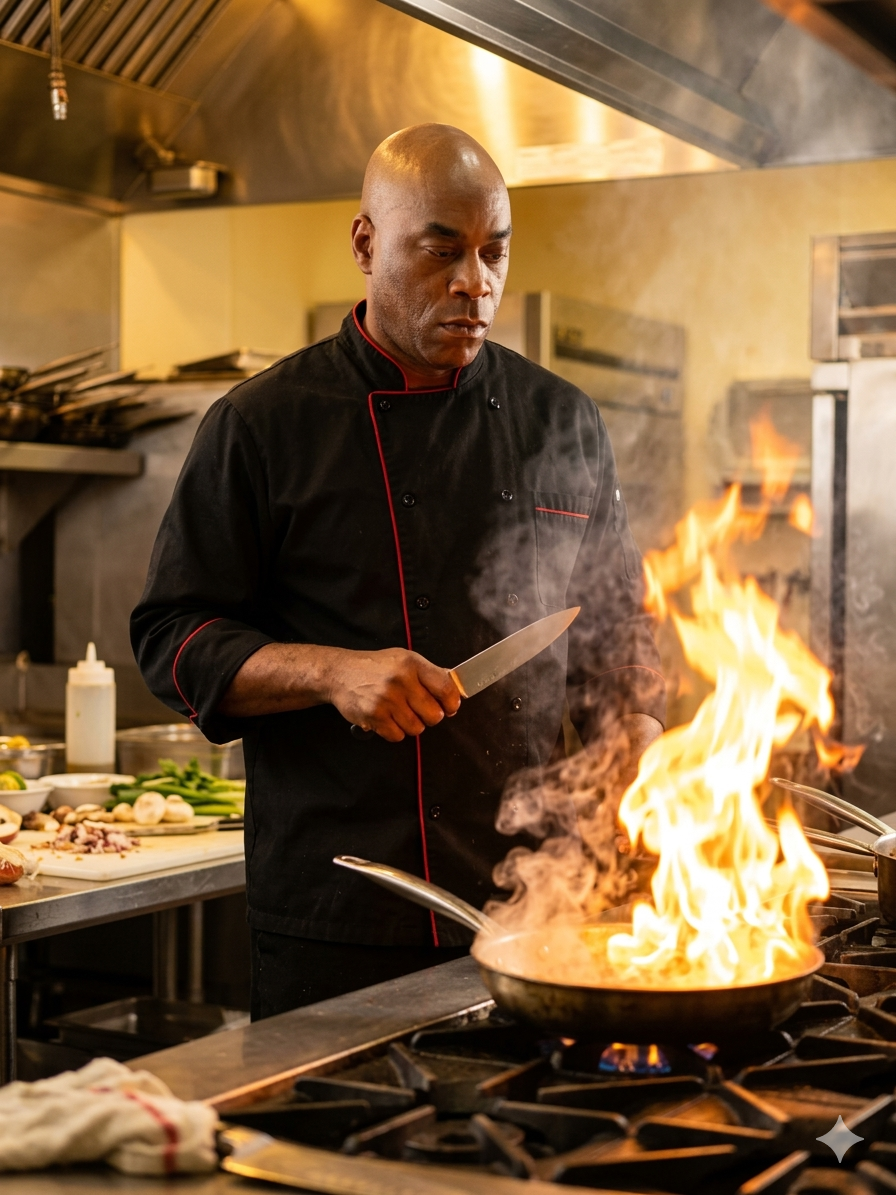
The Business of the Kitchen
Lesson Objective
Develop a foundational understanding of restaurant economics — how kitchens generate revenue, control costs, and create profit — so you can make decisions that support the business, not just the food.
Why It Matters
Most cooks think their job is to cook food. That is true, but incomplete.
The job is to cook food in a way that supports a sustainable business. A cook who makes beautiful food but wastes ingredients, ignores portion standards, or creates operational inefficiency is not doing their job fully.
Understanding the business of the kitchen is not about becoming an accountant. It is about understanding how your decisions affect the financial health of the operation — and making decisions accordingly.
The chef mindset: ownership, accountability, and constant improvement.
The Core Lesson
Restaurant economics operate on thin margins. The average restaurant profit margin is 3-9% of revenue. This means that for every $100 in sales, the restaurant keeps $3-9 after all costs. The primary costs are food cost (typically 28-35% of revenue), labor cost (typically 30-35%), and overhead (rent, utilities, equipment — typically 15-20%). Understanding these numbers helps cooks understand why food cost control, portion discipline, and efficiency are not optional — they are existential.
Food cost is the cost most directly influenced by kitchen behavior. Every time a cook over-portions, wastes product, burns something, or fails to use trim, they are directly increasing food cost. Conversely, every time a cook portions accurately, uses trim creatively, minimizes waste, and maintains product quality, they are directly supporting the restaurant's financial health. The cook who understands this sees their daily decisions differently.
Labor cost is the second major variable. A kitchen that runs efficiently — with good mise en place, clear communication, and minimal waste motion — requires less labor to produce the same output. A kitchen that runs inefficiently — with poor prep, unclear communication, and constant firefighting — requires more labor. The cook who contributes to efficiency is contributing to labor cost control.
The concept of menu engineering is important for cooks who aspire to leadership. Menu engineering analyzes each menu item by its popularity (how often it is ordered) and its profitability (how much margin it generates). Items that are both popular and profitable are stars — they should be featured prominently. Items that are popular but not profitable are plowhorses — they drive volume but need cost management. Items that are profitable but not popular are puzzles — they need better marketing. Items that are neither popular nor profitable are dogs — they should be reconsidered.
The most important business insight for cooks is that financial awareness is a leadership skill, not a management function. Cooks who understand the business make better decisions, communicate more effectively with ownership, and advance faster than cooks who see financial considerations as someone else's problem.
Leadership in the kitchen is earned, not assigned.
Example Scenario
A cook consistently over-portions proteins by 0.5 oz per plate. The restaurant serves 200 covers per night, 6 nights per week. The protein costs $12 per pound.
0.5 oz × 200 covers × 6 nights = 600 oz per week = 37.5 lbs per week 37.5 lbs × $12 = $450 per week in excess food cost $450 × 52 weeks = $23,400 per year
One cook, one small habit, $23,400 in annual food cost. This is why portion discipline is not optional.
Rookie Mistakes
- Thinking financial considerations are someone else's problem
- Not understanding how daily kitchen decisions affect food cost
- Over-portioning without understanding the cumulative financial impact
- Wasting trim and byproducts without considering their cost
- Not connecting kitchen efficiency to labor cost
The Professional Standard
Restaurant margins are thin — 3-9% — every kitchen decision matters financially
Food cost is the cost most directly influenced by kitchen behavior
Menu engineering: stars, plowhorses, puzzles, dogs — know where each item sits
Financial awareness is a leadership skill — cooks who understand the business advance faster
Portion discipline is not optional — the cumulative impact of small over-portions is enormous
Chef Wisdom
"A cook who understands the business of the kitchen is worth more than a cook who just understands the food. The best chefs are both — and they build their careers on both foundations."
— 25 Years in Professional Kitchens
Workbook Reflection
Write your answers below. These are saved automatically in your browser.
Extended Study
The economics of the restaurant industry are uniquely challenging. According to the National Restaurant Association, approximately 60% of restaurants fail within their first year, and 80% fail within five years. The primary causes are undercapitalization, poor location, and — most relevantly for kitchen professionals — poor cost control.
Food cost control is particularly critical because it is the cost most directly influenced by kitchen behavior and the cost most subject to daily variation. A kitchen that consistently runs food cost at 32% versus 38% generates significantly more profit on the same revenue — the difference can be the margin between profitability and failure.
This is why chefs who understand food economics are so valuable to restaurant operators. They are not just cooking — they are protecting the financial viability of the business.
Kitchen Simulation
A restaurant does $50,000 in weekly revenue. Food cost is currently running at 36%. The target is 30%. Calculate: how much money is being lost weekly to the food cost gap? What are three specific kitchen behaviors that could close this gap? What would the annual impact be of closing the gap?
Mastery Quiz
Test yourself before revealing answers. These questions come directly from your certification exam.
Take It to the Kitchen
For one week, track one food cost behavior in your kitchen: portion accuracy, waste reduction, or trim utilization. Estimate the daily cost impact of the behavior you observe. Write your findings and one specific recommendation for improvement.
YouTube: 'Restaurant Economics — What Every Cook Needs to Know' | Textbook Chapter: The Financial Architecture of the Professional Kitchen | Certification Module: Business Literacy Assessment | Simulation: Food cost calculation exercise | Case Study: How kitchen behavior changes saved a restaurant $80,000 annually